Your GNPS newsletter. May not display properly in Microsoft outlook.
If you're having trouble viewing this email, you can see it online.
January 2025 — Volume XXXI, Number 1 — Published by the Georgia Native Plant Society
2025 Plant of the Year: Blue-eyed Grass
Valerie Boss
Blue-eyed grass, Sisyrinchium angustifolium (photo by Ellen Honeycutt).
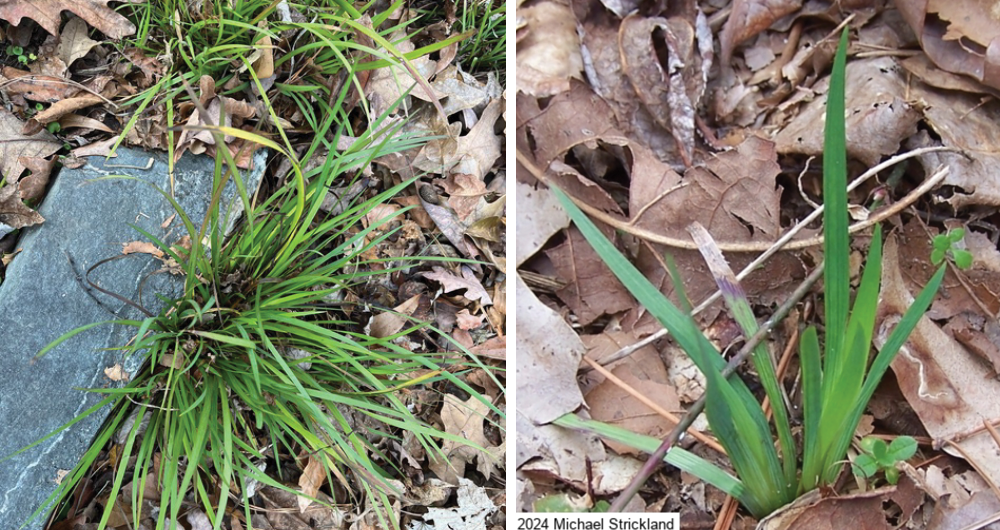
GNPS is pleased to introduce blue-eyed grass (Sisyrinchium angustifolium) as our 2025 Plant of the Year. Blue-eyed grass is a low-growing monocot, with straight, flat, narrow leaves. It can look a lot like a clumping grass, especially when the foliage becomes thick and crowded, but grass is a misnomer. Blue-eyed grass is a member of the iris family, Iridaceae. The resemblance to irises becomes more apparent when few leaves are present, revealing foliage that is fan-shaped, having equitant leaves.
Left: Grasslike character of Sisyrinchium angustifolium (photo by Valerie Boss). Right: Resemblance to other irises when less foliage is present (photo by Michael Strickland).
Blue-eyed grass blooms from March through May. Leafless, branched stalks poke up from the base, each bearing multiple six-parted flowers. Only one flower per stalk blooms at a given time, but clumps can have many stalks and are often decked with flowers. Flower buds emerge from within a single spathe (papery covering), which is typical for members of the Iridaceae family. Each flower is less than 1 inch across, with identical sepals and petals, called tepals. These are oval, with pointed tips that jut out from the terminal end. The flower color is bright blue or sometimes violet. The hue darkens close to the center, which is vivid yellow. In late spring, the flowers of blue-eyed grass begin to develop into seedheads shaped like round balls. By late summer, the seedheads turn deep brown and split open, spilling out tiny dark seeds.
Flower close-up, showing blue color gradation and yellow center (photo by Ellen Honeycutt).
Unlike grasses, which have fibrous roots, plants in the Iridaceae family have either underground storage organs (corms or bulbs) or rhizomes. Blue-eyed grass is no exception; the genus Sisyrinchium is rhizomatous. However, there is one aspect in which blue-eyed grass diverges from the general Iridaceae phenotype. Microscopically, a hallmark of the Iridaceae is the presence of calcium oxalate crystals, particularly styloids, within the tissues. Sisyrinchium is one of only 3-4 genera in a family of over 300 genera that lack calcium oxalate crystals entirely.
The genus name Sisyrinchium appears to be derived from the species name for a different member of the Iridaceae family, Barbary nut iris (Morea sisyrinchium). This plant has a corm tunic resembling shaggy goat hair (Greek word “sisyra”), so the appellation makes sense. Why Sisyrinchium was chosen as the genus name for group of plants without a corm is a mystery. The species name angustifolium means “narrow-leafed,” which is a fitting description for a plant with grass-like foliage.
Both foliage and flowers of blue-eyed grass lend character to a planted area, so it is a lovely garden plant. In the wild, the species favors open forest, water edges, and meadows. Tolerant of full or partial sun, it can handle some dryness, but won’t thrive in arid environments. Plant blue-eyed grass in conditions that mimic the natural habitat and it will do fine. It can be found in native plant nurseries and online. Take care not to mistake the non-native, white-flowered, S. iridifolium, aka S. microcanthum, for a variant of the native S. angustifolium. Blue-eyed grass can be propagated by seed, as well as by division. Plants should be divided every few years to maintain vigor; otherwise, clumps may die out. The species makes a great ground cover — consider it as an alternative to liriope — and its flowers attract many bees and butterflies.
Beginning of seed formation (photo by Michael Strickland).
Help us with the next Plant of the Year process! The Plant of the Year committee is seeking additional volunteers to assist in the nomination process. Volunteering will involve reviewing nominations via email in September and attending one or two virtual meetings per year. If you’re interested, please contact Nikki Belmonte.
Wrangle With Us on MLK Jr. Days of Service!
Georgia Native Plant Society will host its second statewide Weed Wrangle on January 20, 2025 during Martin Luther King Jr. Day of Service. Weed Wrangle is a one-day, area-wide, volunteer effort to help rescue our public parks and green spaces from exotic, invasive species through hands-on removal of especially harmful trees, vines and flowering plants.
While many of us work regularly at invasive plant removal, we hope that hosting a statewide weed wrangle will promote awareness, participation and camaraderie during this national day of community service. Participating locations include:
We hope you’ll participate and bring along your friends and family too!
2024 Year in Review
If there was ever a time to use the phrase “growing like a weed” this is it! GNPS had a banner year in 2024. While we continue to grow our presence in Georgia and provide centralized support to our signature programs and chapter network, our 9 affiliated chapters have been working hard on the ground to build participation and affect change in their communities. Click on this 2024 infographic to see a summary of our collective impact. Some additional highlights worth noting:
The year ended with 2,107 memberships, a 17% increase over the beginning of 2024.
A new chapter was born! The Maritime Chapter became an official chapter affiliate, covering the area along the Georgia coast from Savannah to St. Marys.
GNPS received the Birds Georgia 2024 Organization Award which recognizes groups who have dedicated significant work towards bird conservation.
Partnerships and collaborative work continue to grow at both the state and chapter levels. GNPS is an active partner in the Georgia Pollinator Partnership, which now displays GNPS certified habitats on its GAPP map.
The impact that GNPS has throughout Georgia goes beyond this snapshot. You, our members, are the reason for this success. We thank you for your support in 2024 and hope that you will continue to be with us through 2025.
State Board
Thank you to all who voted in our election of the 2025 board of directors. The following new board members began their term on January 1: Melanie DeVore (Milledgeville), Jacqueline Miller (Lithia Springs) and Charlie Monroe (Marietta). This brings the state board up to 16 members. If you missed the election email, you can read the bio profiles of these new board members by clicking here.
Let’s Keep Growing in 2025
This year GNPS will continue to focus on growing our network and increasing our effectiveness. The state board will embark on strategic planning for upcoming years. As members, we encourage you to be active participants so our chapters can continue to flourish. Consider inviting a friend to join you at the next chapter meeting, work day or plant rescue. There are some areas, like Cartersville, Columbus, and communities around Lake Lanier, that are ripe for establishing new chapters. (If you’re interested in helping to start a chapter, please email membership@gnps.org.) There are many ways we can influence a better landscape for Georgia, so let’s keep up the momentum!
Plant Spotlight: Native Evergreen Ferns
Ellen Honeycutt
Winter is a good time to identify where you might like to have more evergreen plants. It is also a good time to consider removing evergreen invasive groundcover plants like English ivy (Hedera helix), wintercreeper (Euonymus fortunei), monkey grass (Liriope), and periwinkle (Vinca). These plants are easy to see and work on during the winter months.
You might use some of our native evergreen ferns. Some of the more commonly available large ones include:
Christmas fern (see the 2019 spotlight on Polystichum acrostichoides here). It was our Plant of the Year in 2008. Its natural range includes all of our ecoregions.
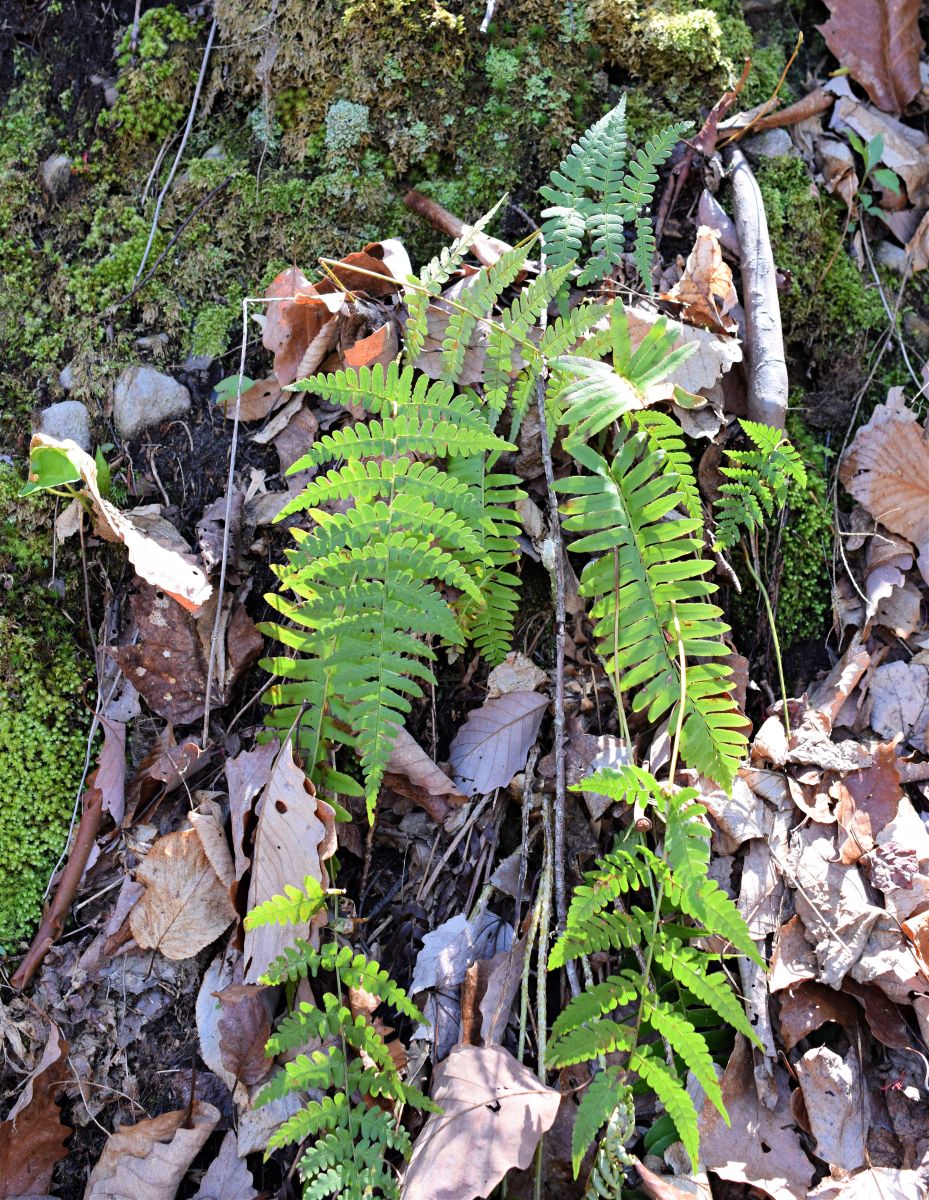
Marginal fern (Dryopteris marginalis) is naturally found in all 3 of our north Georgia ecoregions and is a large and handsome fern. We have 3 other large native ferns in the Dryopteris genus* to consider all well.
Marginal fern, Dryopteris marginalis, with Christmas fern (photo by Ellen Honeycutt).
Intermediate wood fern (Dryopteris intermedia) is a north Georgia fern, even north of the Piedmont ecoregion.
Log fern (Dryopteris celsa) is considered “a fertile allotetraploid derived from hybridization of D. goldieana (a NW Georgia species) and D. ludoviciana" (Flora of the Southeastern United States, or FSUS).
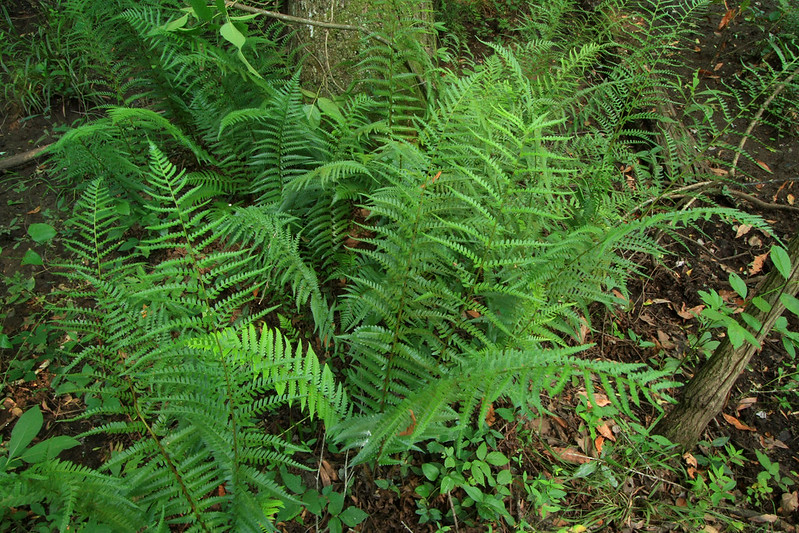
Southern woodfern (Dryopteris ludoviciana) is a large Coastal Plain species that may be only semi-evergreen north of its natural range.
Southern woodfern, Dryopteris ludoviciana (photo by Alan Cressler).
Smaller evergreen ferns include the following:
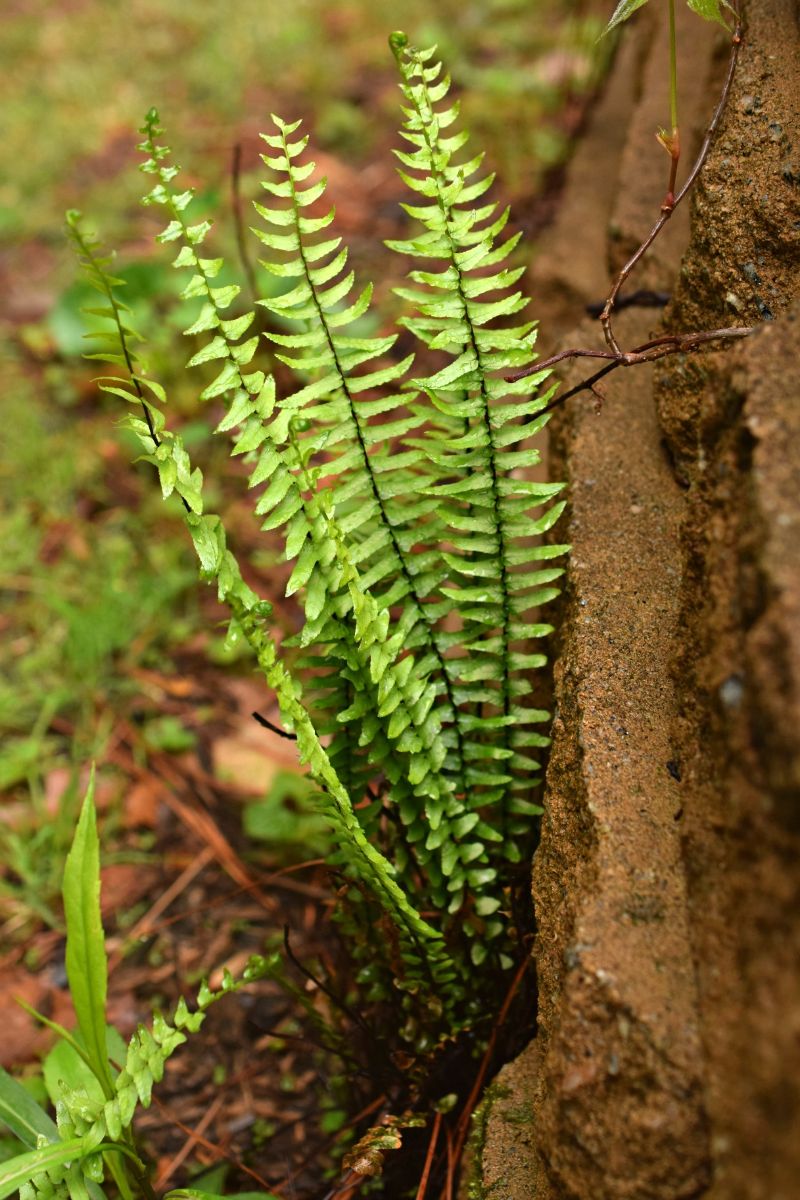
Ebony spleenwort (Asplenium platyneuron) is a fairly drought tolereant slender fern that is native throughout the state. It needs good drainage and is often found adjacent to rocks for that reason.
Ebony spleenwort, Asplenium platyneuron (photo by Ellen Honeycutt).
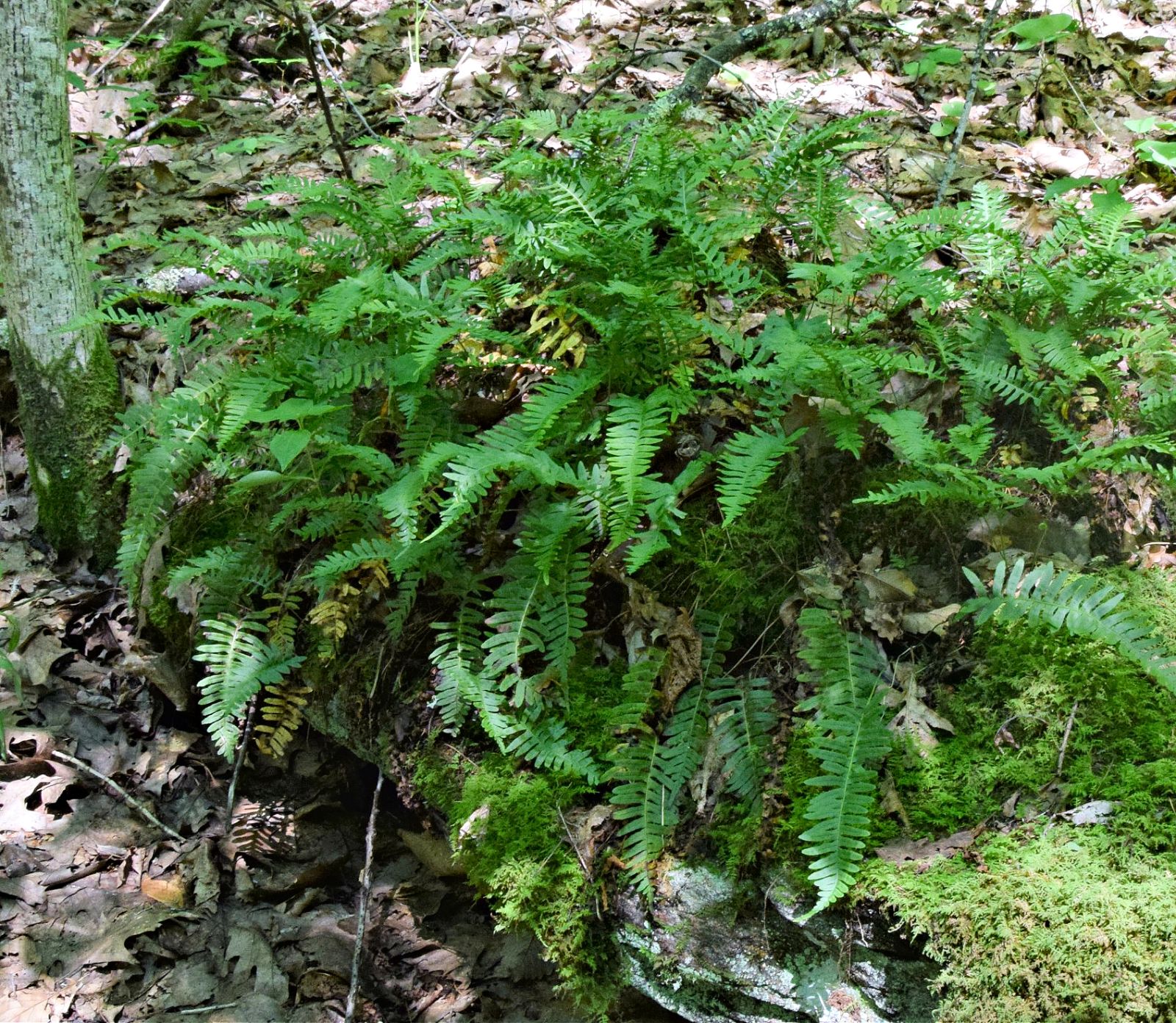
Rockcap fern (Polypodium virginianum) is a small, creeping fern of north Georgia that is slightly larger than resurrection fern. True to its common name, it likes to grow on rocks, ledges, or in crevices.
Rockcap fern, Polypodium virginianum (photo by Ellen Honeycutt).
Resurrection fern (Pleopeltis michauxiana, formerly Pleopeltis polypodioidesper FSUS). See the 2020 spotlight on resurrection fern here). Smaller than the similar-looking rockcap fern, this species can be found on oak tree branches and growing among the old fronds of palms.
Southern maidenhair (Adiantum capillus-veneris) is a lush fern of the southwest Coastal Plain and sometimes in the southern Cumberland Plateau region. The nursery Naturescapes of Beaufort SC advises: “Plant them in part to full shade in average to moist soil. They love calcium, it makes their leaves a beautiful blue-green. They grow well in shelly areas or near masonry work. If you eat eggs, sprinkle the shells around them.”
* Note: Be aware of accidentally choosing an evergreen exotic fern known as Autumn fern (Dryopteris erythrosora) which has become invasive in areas of the metro Atlanta area; it will likely become invasive in other areas of Georgia over time. If you have this fern, please plan to remove it to reduce the spread. Even if you don’t see it as invasive in your yard, the spores can move to other yards and natural areas. If you find it in natural areas, please report it via EDDMapS: https://www.eddmaps.org/
Save the Date: GNPS Annual Symposium February 15-16
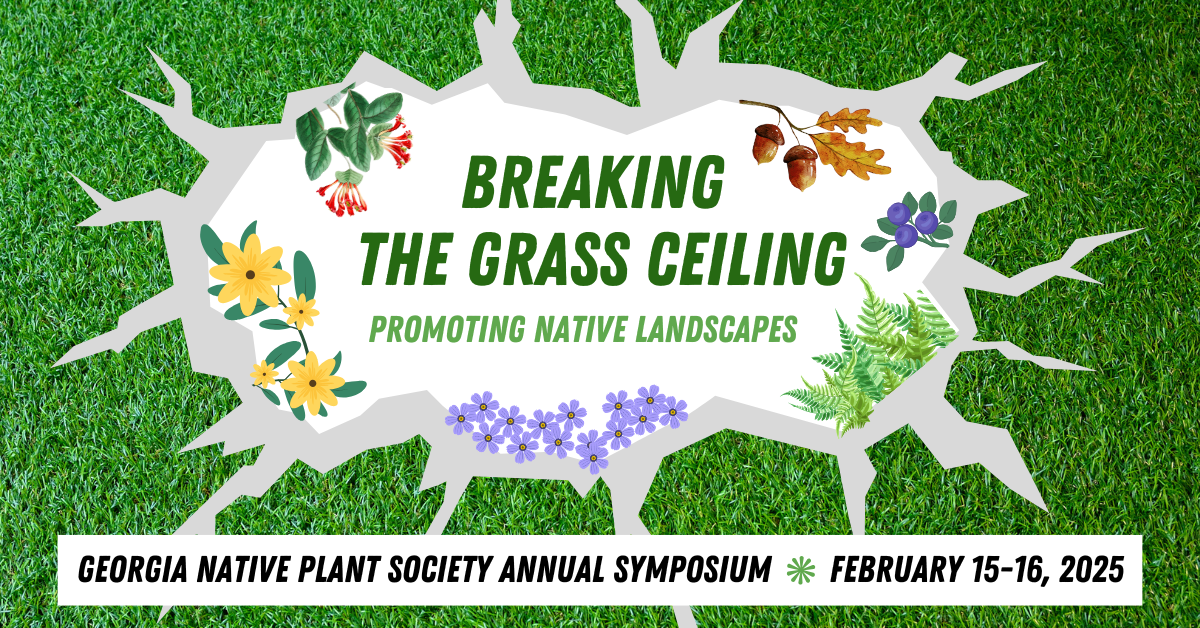
Join us for the GNPS Annual Symposium on Saturday and Sunday, February 15-16. This two-day virtual event will focus around our 2025 theme, Breaking the Grass Ceiling: Promoting Native Landscapes. The program schedule and registration will be available later in January - stay tuned!
New Year, New State Flower
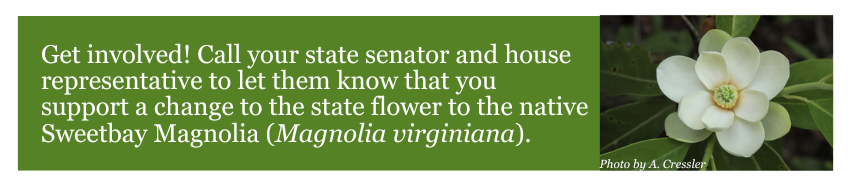
The 2025 State Legislative Session has begun and the GNPS state advocacy committee is working with several state senators and representatives to co-sponsor a bill to change the state flower from the exotic Cherokee rose to the native sweetbay magnolia. The movement has received decent press coverage around the state and it’s time for the final push. How can you get involved? Refer to the GNPS advocacy webpage that has an information sheet, tips sheet (including what to say to your legislators) and a FAQ. If you have any questions, please reach out to Advocacy Chair, Michael Cowan at michael.cowan@gnps.org.
Chapter Updates
Athens-East Piedmont
Surviving Extinction: The Mystery and Majesty of Franklinia, January 12
This program has been rescheduled from a previous November date. Join us on Sunday, January 12 from 2:00-3:30 p.m. at the Unitarian Universalist Fellowship of Athens (780 Timothy Road, Athens) to hear Heather Gladfelter, post-doctoral student at UGA, give her presentation “Surviving Extinction: The Mystery and Majesty of Franklinia.” Franklinia alatmaha, the Ben Franklin tree, is considered to be extinct from the wild for centuries but survives thanks to the horticulture trade. Heather’s research provides insights about why this is the case. Plants of the Franklinia will be available for sale (4” plants for $10 each, cash only) and sales will support her research.
Also, join in the chapter seed swap: bring your extra seeds to share with others and maybe find new treasures to take home!
Oconee Veterans Park Collaborative Project Presentation, February 12
Join us on Wednesday, February 12 from 6:00-7:30 p.m. at Sandy Creek Nature Center (205 Old Commerce Road, Athens) when Mincy Moffet will share a potential collaborative project for our chapter along with the State Botanical Garden of Georgia, the Georgia Dept. of Natural Resources and U.S. Fish and Wildlife Service. These agencies are working closely together (under the Georgia Plant Conservation Alliance umbrella, an organization of which GNPS is a part) on a project at the Oconee Veterans Park focused on native grassland restoration, pollinator plants, and rare plant conservation. The hope is that the project will become an interpretive site and a front-facing demonstration project for the Georgia Native Seed Network.
Augusta’s River Region
Stay Tuned for Weed Wrangle Georgia Location
Augusta's River Region is getting back in the swing of things post-Helene and plans to participate in the Weed Wrangle Georgia during MLK Jr. Day of Service on Monday morning, January 20. The location is TBA, but will most likely be Phinizy Swamp Nature Park, as most of our other parks and natural areas still have limited or no access due to storm damage.
Native Garden Tours Initiative Enters Second Year
The chapter’s Native Garden Tours Initiative will kick off the new year with its 11th property visit. This initiative offers complimentary customized property assessments to landowners who want to grow native plants and to provide more sustainable wildlife habitats. The group itemizes existing plants and identifies invasive species on properties of varying sizes, then provides a proposal with short-and long-term timelines, visuals, and vendors for suggested plants and seeds. They also point out possible grant sources and habitat certification programs to qualifying property owners.
Chapter members Eamonn Leonard and Martha Joiner were recognized by the Georgia Plant Conservation Alliance (GPCA) with the Good Egg Award for their years of volunteer work with native plant conservation at the annual GPCA symposium held in Athens on November 6-8, 2024. GPCA is a network of more than forty universities, botanical gardens, zoos, state and federal agencies, conservation organizations, private companies and individuals committed to native botanical preservation and protection.
Fringed Campion
Fringed Campion is gearing up for several work days in January. Check our Facebook page for updates on our programs and events. You can also contact us with any questions at our email: fringedcampion@gnps.org.
Intown Atlanta
A Year in Native Gardening in Atlanta, January 26
Join us on Sunday, January 26 from 1:00-3:00 p.m. at Hawkins Hall at Legacy Park in Decatur for an updated and improved presentation on invasive plant removal and native gardening in every season with Woods Keeper’s Michael Hudgins and Intown Atlanta GNPS board member Laura Qadri. This information-packed talk will cover the right times to identify and remove selected invasive plants in our area, native plants to incorporate in your landscape for visual interest and wildlife habitat in every season, and key tasks to maintain and improve your native garden throughout the year.
Stay for refreshments and mingling after the presentation, and take home some free native seeds! We will also have a supervised craft table for kids during the presentation. Space at the kids’ table is limited; reserve a spot by emailing lauren.owens@gnps.org.
This popular event fills up quickly. If registration is full, sign up for the waitlist to get notified when seats become available. Register Now!
Save the Date and Volunteer for the Seed & Scion Exchange, February 23
The Intown Atlanta chapter is hosting/supporting the native plant seed table at the Wylde Center’s Seed & Scion Exchange on Sunday, February 23, from 2:00-4:00 p.m. at Legacy Park in Decatur. Start collecting and organizing your seeds and seedlings now. If you’d like to help with seed sorting and answering questions about native plant gardening, please email lauren.owens@gnps.org to volunteer.
North Georgia Mountains
Chapter Meeting, January 11
Join us to hear Brian Hale’s presentation on fungi at our meeting on Saturday, January 11 at 10:00 a.m. at the Blairsville Public Library.
Speakers Needed for 2025
The North Georgia Mountains chapter is looking for speakers for a couple open slots in our second Saturday chapter meetings. If you have an idea for a program or a great speaker recommendation, please contact Teryn Romaine.
West Georgia
Prepping Your Tools For Spring, February 11
It’s almost time to start playing in the dirt again. Are your tools ready? The West Georgia Chapter’s February meeting will focus on getting your gardening tools ready for spring and keeping them in good shape year-round. Our speaker, Mike Handyside, is an expert on this topic. Mike has a background in metalwork, is a Friend of the Carroll County Master Gardeners, and is responsible for maintaining the tools used in the CCMG Demo Garden.
Bring a tool that needs sharpening, and Mike will walk us through the sharpening process. You’ll leave with one nice sharp tool and the skills to keep it that way.
There will be a reception at 6:30 p.m. with light refreshments, followed by the presentation at 7:00 p.m. Everyone is welcome, so feel free to bring a friend!
Thank You to our Organizational Members & Sponsors
%20clumps%20are%20full%20of%20spring%20flowers.jpeg)
%20blue%20flowers%20have%20bright%20yellow%20centers.jpeg)
%20flowers%20start%20turning%20to%20seed%20in%20May.png)