Your GNPS newsletter. May not display properly in Microsoft outlook.
If you're having trouble viewing this email, you cansee it online.
January 2026 — Volume XXXII, Number 1 — Published by the Georgia Native Plant Society
Introducing the 2026 Plant of the Year: Pawpaw
Valerie Boss
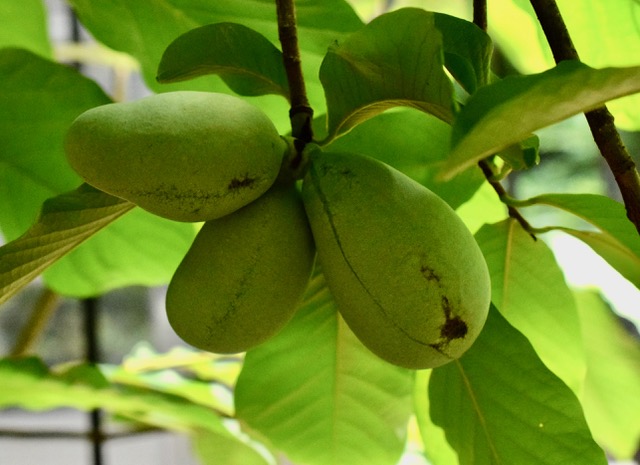
Pawpaw fruits before the leaves turn yellow.
The GNPS Plant of the Year for 2026 is pawpaw (Asimina triloba). Most Americans are familiar with cultivated, non-native fruit trees, such as peaches, oranges, and apples, but are unaware of pawpaw, a native tree that produces the largest edible fruit indigenous to North America. Growing wild in eastern woodlands, but also cultivable, pawpaw’s fruit is both tasty and nutritious. Pawpaw’s range covers much of the eastern US, extending as far north as southern Ontario, west to Nebraska, and south as far as middle Georgia and parts of Texas.
Pawpaw belongs to the Annonaceae family. In 1753, Linneus named it Annona triloba, and in a 1791 travel journal naturalist William Bartram called it Annona grandiflora. Both men placed pawpaw in the family’s type genus, which includes tropical and subtropical fruit trees such as cherimoya and custard apple. Pawpaw was later assigned to the genus Asimina, composed of a small collection—about a dozen species--- of Annonaceae members that thrive in temperate regions. Linneus was not the first European to describe pawpaw. That honor falls to Hernando de Soto’s expedition, who came upon native Americans cultivating the plant in the Mississippi Valley in the 1500s.
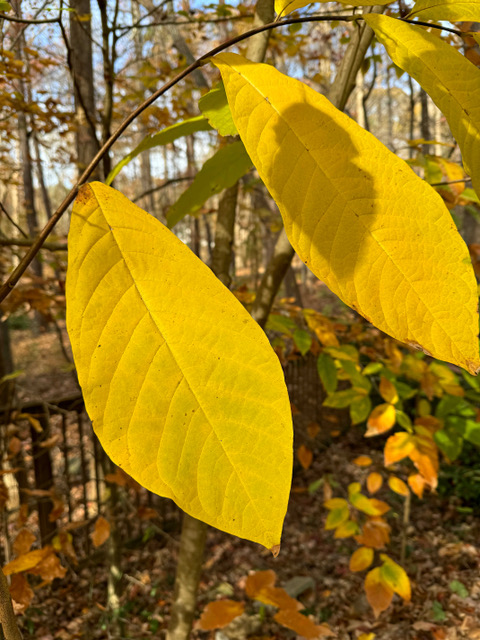
Pawpaw has golden autumn foliage.
Pawpaws are understory trees, reaching as high as 35’. The trunks have grey bark, and the leaves are distinctive, growing up to 12” long and 6” wide. Simple, non-toothed, and elliptical, with slight points at the ends, these leaves have a strong central vein and parallel side veins. They grow in an alternate pattern and tend to droop. The droop is particularly noticeable in saplings, where the stems often arch, pointing the leaves towards the ground. Although they are an ordinary green in summer, the leaves turn a rich yellow in autumn.
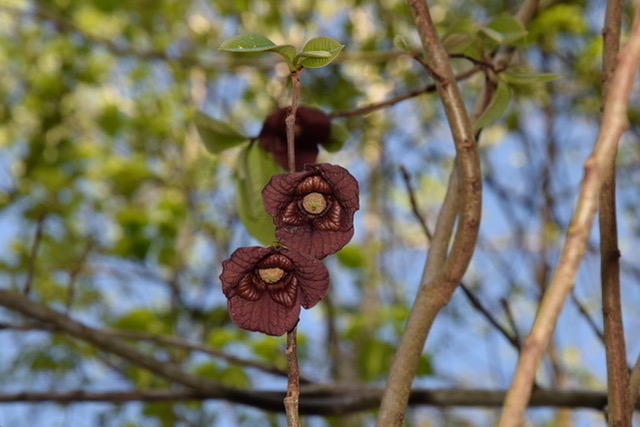
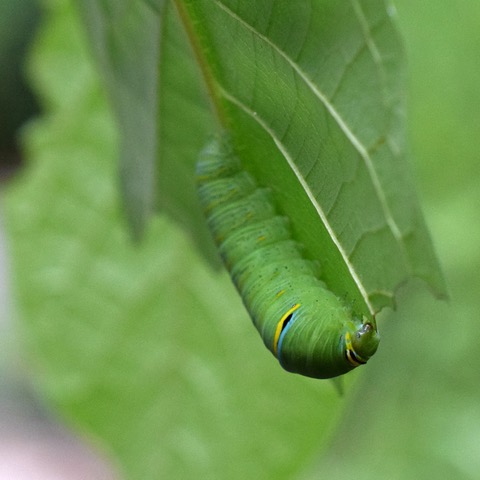
Before spring leaves emerge, pawpaw’s flowers burst forth singly from buds along the distal ends of the branches and branch termini. Each flower is about 1-1.5” across, 6-petaled (3 inner and 3 outer), and dark maroon-brown. They smell rotten to people, but their odor attracts beetles and flies, the plant’s main pollinators. Pawpaws also attract the zebra swallowtail (Eurytides marcellus) and pawpaw sphinx moth (Dolba hyloeus). The tree is their larval host.
Flowers bloom in early spring.
Nature has ensured that pawpaws don’t self-pollinate. Individual pawpaw flowers are complete (they have both pistils and stamens), but also protogynous--the female parts mature before the male parts, making it impossible for individual flowers to fertilize themselves. In addition, flowers on the same tree are not self-compatible. With the exception of a few cultivars, pawpaw trees reject their own pollen. Thus, only genetically distinct individuals can cross-fertilize.
Pawpaw’s eponymous fruit goes from green to yellowish or brown before falling on the ground when ripe in autumn. Pawpaws are about the size of avocados, but their shape is more mango-like. Their pulp is only ready to eat when the fruit softens (the skin and large, black seeds are inedible). The pulp’s flavor varies depending on the growth conditions and ripeness, but has similarities to banana, papaya and mango. Pawpaws have a caloric value that resembles that of bananas, and contain minerals, Vitamin C, and natural anti-oxidants. Both humans and small mammals like to eat them. Unfortunately, they have a short shelf life.
Zebra swallowtail larvae feed on the leaves.
Native Americans, including the Lenape, Iroquois, Algonquin, and Cherokee, harvested pawpaw for food, but also other uses. Powdered seeds were used to control head lice, and fibers from inner bark were woven into bags, twine, and fish nets. Pawpaw was also used medicinally-- the leaves, twigs and fruit skin contain acetogenins and alkaloids that are strongly emetic and potentially quite toxic.
Pawpaw trees grow naturally in rich woodlands and hillsides near streams. They are not difficult to cultivate, although the seeds require cold stratification. Pawpaws like partial shade, but can take full sun, provided that they are protected from the afternoon sun as seedlings. Once established, pawpaws can survive short, but not prolonged droughts. Adult trees tend to sucker and form clonal (genetically identical) colonies, so give them room to spread, or plan to cut the clones. Plant two or more seed-grown trees, or trees grafted from different parents, give them moisture and at least partial sun, and in 3-8 years prepare to harvest delicious fruit.
Photos by Ellen Honeycutt.
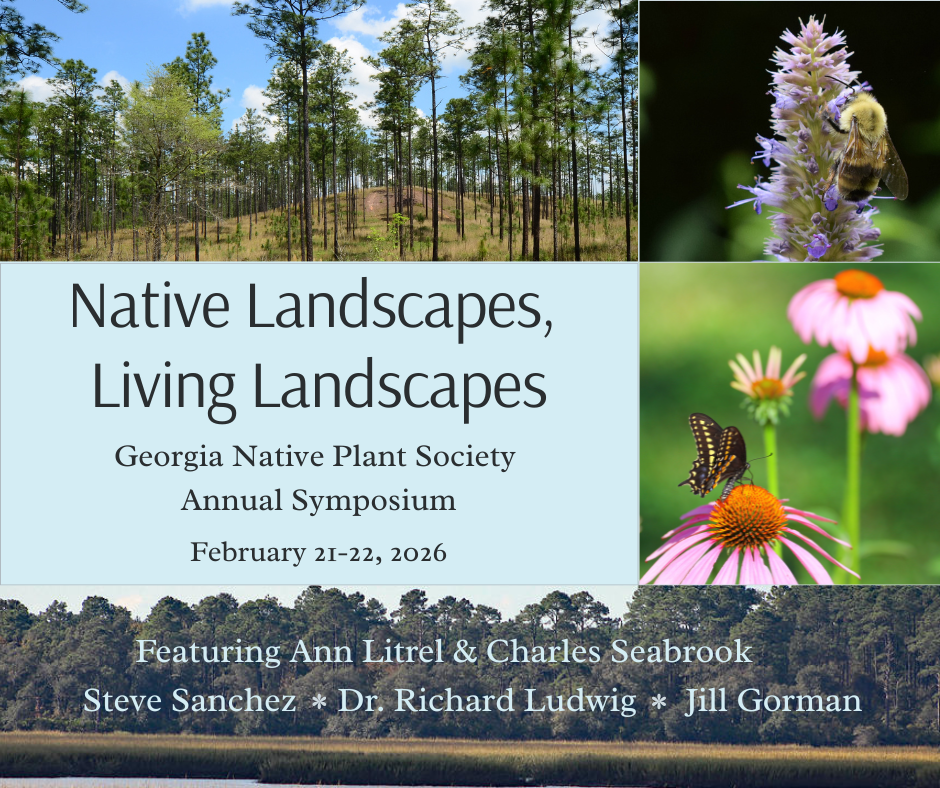
Save the Date! GNPS Annual Symposium, February 21-22
Registration for the 2026 GNPS Annual Symposium will open soon after the new year. This year’s speakers will show how native plants bring vibrant life and beauty in both natural and managed landscapes and highlight ways you can design and plant sustainably in your yard. This will be a virtual program across two days, and tickets will be available for one or both days. Stay tuned for details!
2025 Year in Review
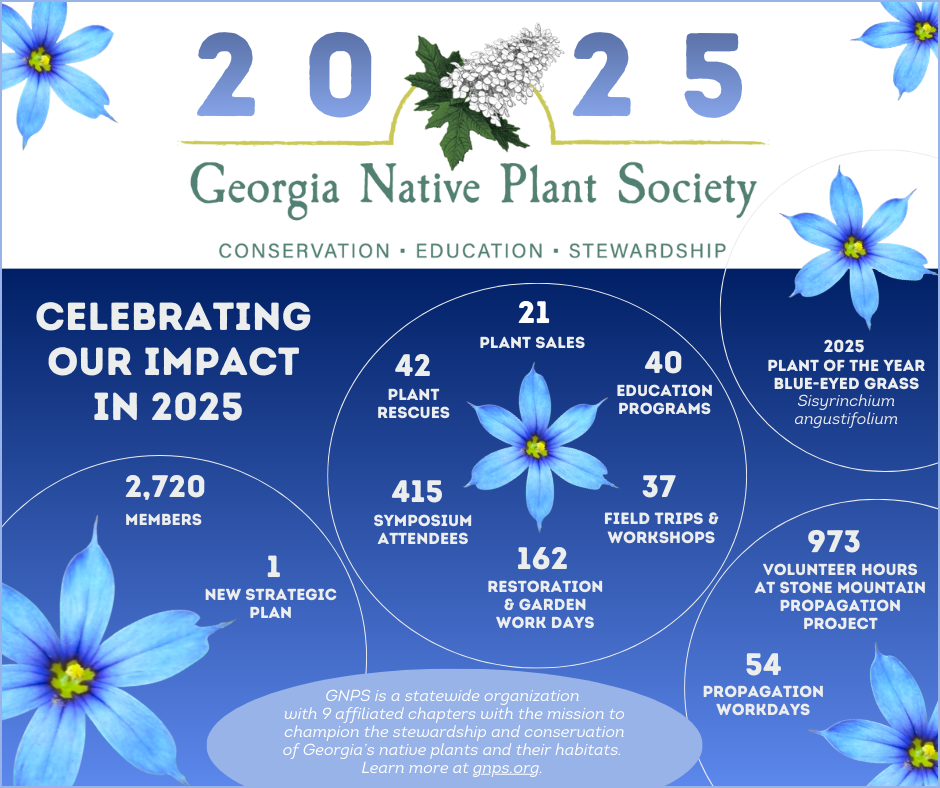
Before we charge ahead into this new year, let us reflect on the awesome year we had in 2025. While we continue to grow our presence in Georgia and provide centralized support to our signature programs and chapter network, our nine affiliated chapters have been working hard on the ground to build participation and affect change in their local communities.
The impact that GNPS has throughout Georgia goes beyond this snapshot. You, our members, are the reason for this success. We thank you for your support in 2025 and hope that you will continue to be with us through 2026 and beyond!
We would also like to express gratitude to the six outgoing board members for their outstanding contributions: Michele Buchanan, Lori Conway, Amy Heidt, Ellen Honeycutt, Ron Smith, and Tom Collins. Beginning January 1, four new members join the State Board of Directors: Heather Kirk-Ballard (Athens), Joe Lamp’l (Milton), Jim Ozier (Barnesville) and Jamie Vidich (Atlanta). We look forward to another productive year!
Statewide News and Opportunities
Winter Weed Wrangles
GNPS will host its third statewide Weed Wrangle on February 16, 2026 (President's Day). Weed Wrangle is a one-day volunteer effort to help rescue our public parks and green spaces from exotic, invasive species through removal of especially harmful trees, vines and flowering plants. Winter is a great time to see and remove many of the invasive, exotic species in Georgia, so check out one of these upcoming wrangles! While the official date is February 16, there are opportunities on January 19 (Martin Luther King, Jr. Day) as well. More events will be added as details are confirmed.
Subscribe to our Community-Supported Propagation Updates
Learn more about the GNPS Community-Supported Propagation program by subscribing to our weekly updates. Details on what’s happening at Stone Mountain Propagation Project and Boy Scout Road Nursery, including specifics on volunteer days, will be shared through this weekly update. If you already receive updates from SMPP or BSRN, you are already subscribed and no action is needed!
For those who want to subscribe, you can subscribe to one or both propagation sites. ALL subscribers will receive a weekly update about the whole Community-Supported Propagation program. Sometimes we need to send site-specific information such as time changes or cancellations. Follow these steps:
From the menu on the left, choose Address and Account Preferences.
Scroll down to the Preferences section and choose “Yes” under Stone Mountain Propagation Project List and/or Boy Scout Road Nursery Propagation List.
Remembering Julian Deal, GNPS Past President
We are sad to share the passing of past president, Julian Deal. In addition to being president in 1999, Julian was instrumental in securing the first and oldest GNPS restoration site at Heritage Park in Cobb County, inspiring others to designate more sites and volunteer thousands of hours of restoration work over the last 15 years.
Chapter Updates
Athens-East Piedmont
Chapter Meetings in 2026
The Athens-East Piedmont Chapter will hold meetings most months this year during the second week of the month. In odd-numbered months we meet on Sunday afternoons from 2:00–3:30 p.m. and even-numbered months on Wednesday afternoons from 6:00–7:30 p.m.
Our first meeting in January will feature Sherrie Hines with great information on growing native plants from seeds. Details for this meeting will be posted on our webpage and in our chapter monthly newsletter as soon as we have them. Visit our chapter’s webpage or join our Facebook group for more information on upcoming programs.
Augusta’s River Region
Chapter Meeting, January 8
Join us at 6:30 p.m. in the parish hall at St. Augustine's Episcopal Church (3321 Wheeler Road, Augusta) to hear professor of botany and dean emeritus Gloria Caddell of the University of Central Oklahoma, who is also our treasurer Mary Caddell's sister! She will present on winter botany with a focus on hardwood identification, so bring a magnifying glass if you have one.
Save the Date: South Georgia Native Plant and Wildflower Symposium
Mark your calendars for the annual South Georgia Native Plant and Wildflower Symposium scheduled for Wednesday, March 25, 2026, from 8:30 a.m.–3:00 p.m.
Fringed Campion
Grant Received for Ocmulgee Mounds Planting
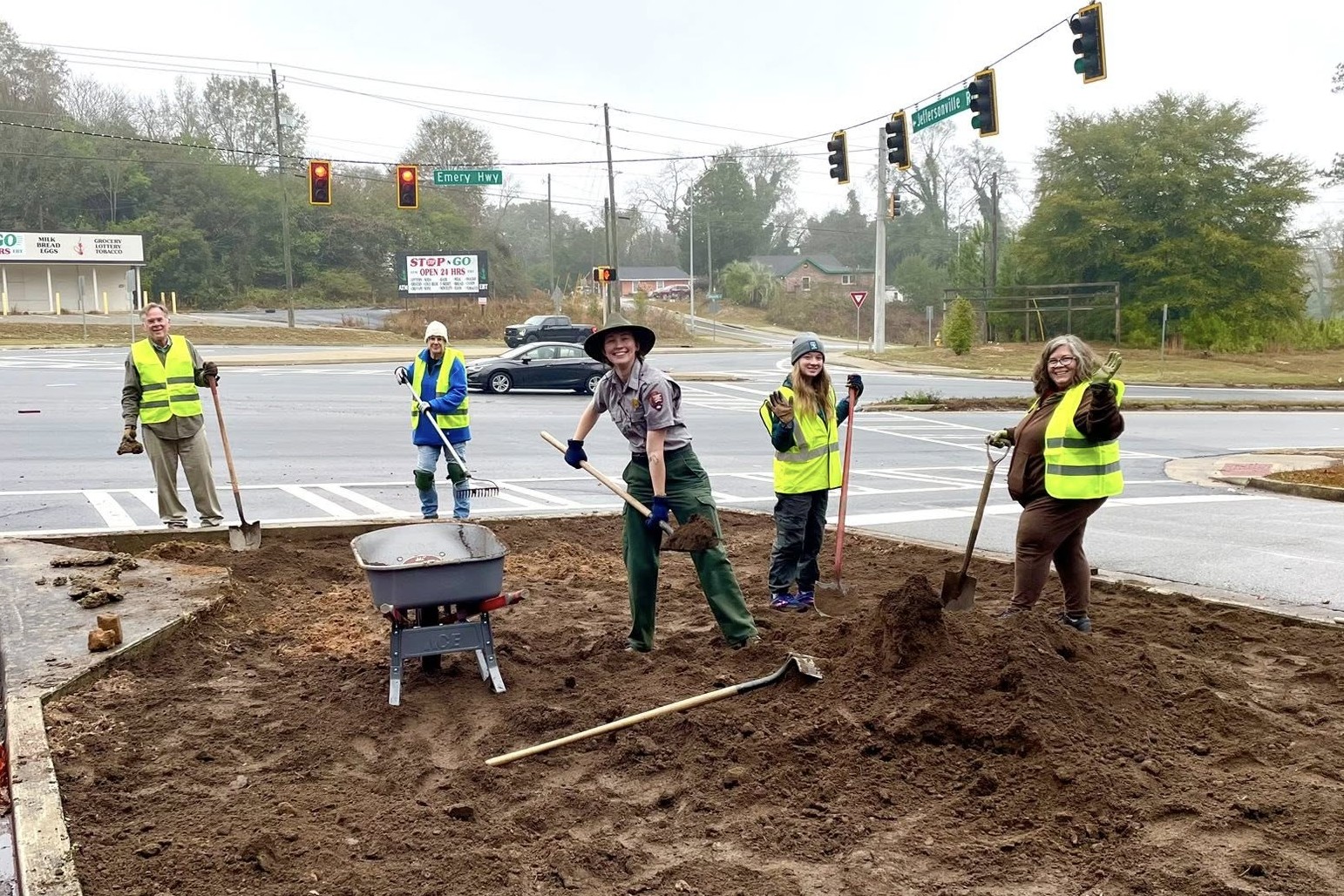
The Fringed Campion Chapter received a grant for $1,500 from the Peyton Anderson Foundation to help finance the Ocmulgee Mounds National Historic Park Native Plant Entry Way Garden project. Site preparation and planting began in December.
Wildflower Meadow in Progress in Warner Robins
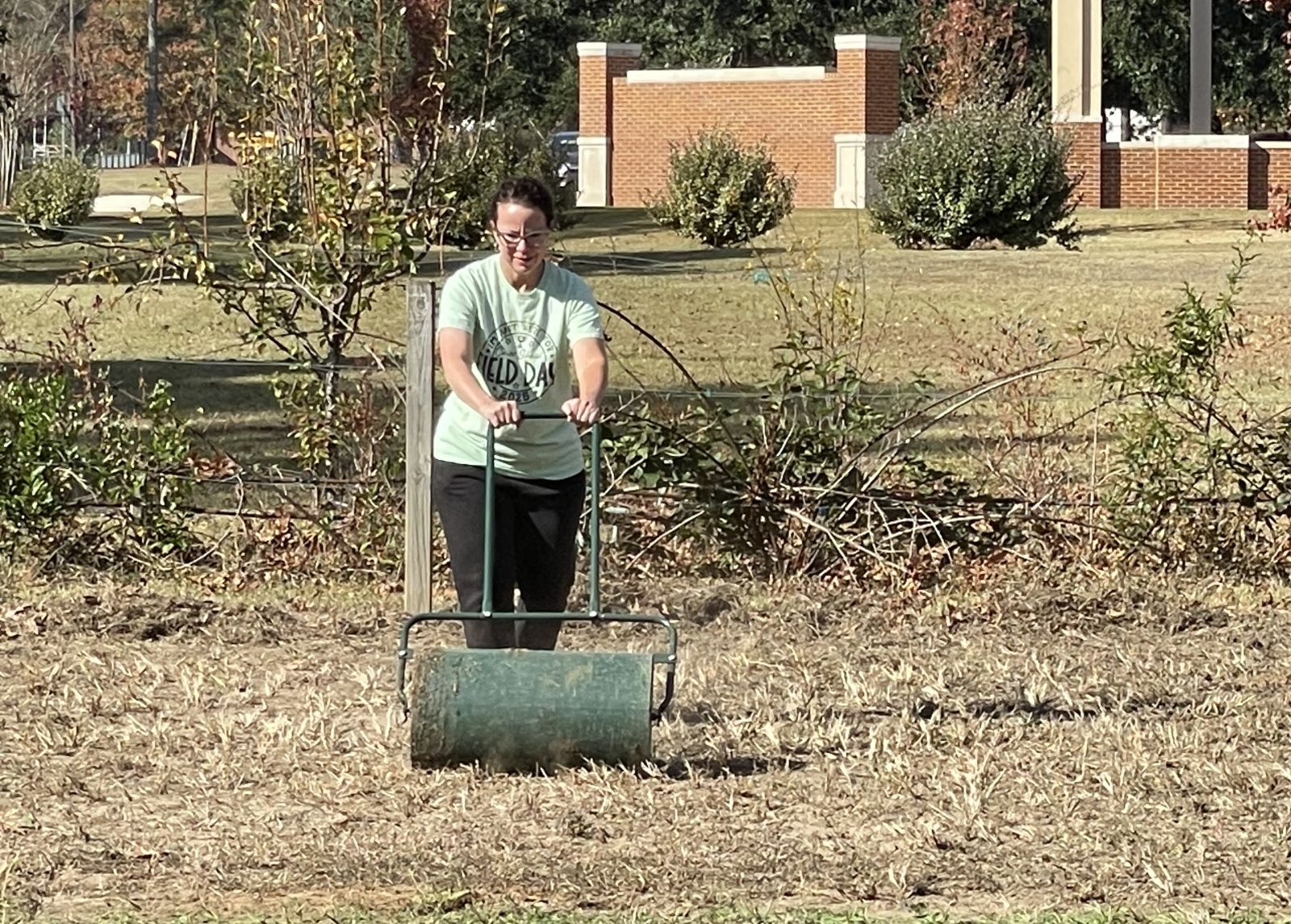
The Wildflower Meadow at Sacred Heart Church in Warner Robins is a new GNPS Educational Garden. It was planted and seeded in November — we can’t wait to see it in the spring and summer! Learn more about the requirements for Educational Gardens on the GNPS restoration webpage.
Keep updated on our upcoming events and projects by checking out our Facebook page.
Intown Atlanta
Year-Round Native Gardening in Atlanta, January 25
On Sunday, January 25, Woods Keeper’s Michael Hudgins and Intown GNPS board member Laura Qadri will be back at Legacy Park with Intown’s most popular talk. This newly updated presentation will discuss how to time and prioritize gardening tasks and invasive plant removal to efficiently and effectively increase the habitat value of your landscape. Come learn how to create a space that is both beautiful and supportive of biodiversity all year long.
Stay for refreshments and mingling after the presentation. Tickets are $5 for members and $10 for nonmembers, and registration is required. This event sells out every year, so don’t wait to register! Click here to register.
Invasive Plant Removal Workshop
Save the date for Saturday, February 7 from 1:00 – 3:00 p.m. for an invasive plant removal workshop at Herbert Taylor and Daniel Johnson Park. Experts will provide tips on how to identify and remove invasive species as well as perform hands-on demonstrations. More information and registration link coming soon!
Restoration Site Workdays
Come out to one of our restoration site workdays to learn about invasive plant removal and repair damaged habitats at our local parks.
Join us on Saturday, January 10 at the Union County Public library in Blairsville from 10:00 a.m.–12:00 p.m. to hear Glen Henderson, Preservation Chairman for the Georgia Mountain Research and Education Center, present “The Gardens, Which Plants for Which Environments, Sources For Plants.”
Subscribe to our YouTube Channel
Can’t make it to our meetings? The North Georgia Mountains Chapter meetings are available on our YouTube channel. Subscribe today!
North Metro Atlanta
Explorations of Native Plants in the Piedmont: How Did They Get Here? The Spread of Invasive Plants, January 28
Dr. Jon Storm, Professor of Biology at University of South Carolina Upstate will share his knowledge on why invasive plants, such as kudzu and multiflora rose, were introduced to the United States and how they spread across the southeast. Join us on Wednesday, January 28 from 7:00–8:00 p.m. for this free virtual webinar. Register here.
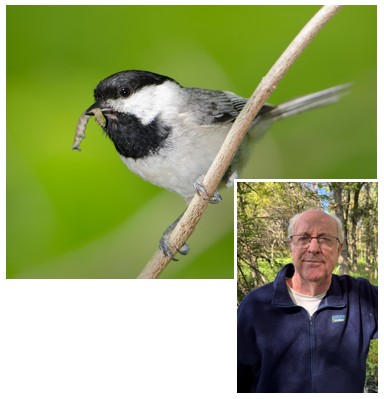
Exploring Native Plants: A Chickadee’s Guide to Gardening with Dr. Doug Tallamy, February 11
In the past, many have designed our landscapes strictly for their own pleasure, with no thought to how they might impact the natural world around us. Such landscapes do not contribute much to local ecosystem function and support little life. Using chickadees and other wildlife as guides, Tallamy will explain how plants that evolved in concert with local animals provide for their needs better than plants that evolved elsewhere. In the process he shows how creating living landscapes by sharing our spaces with other living things will not reduce our pleasurable garden experiences, but enhance them. Join us on Wednesday, February 11 from 7:00–8:00 p.m. for this free virtual webinar. Register here.
Native Plant Rambles
Join your fellow North Metro Atlanta Chapter members for an educational walk in the woods. These "rambles" offer a great way to learn about the native plants and to meet new friends who are also native plant enthusiasts!
Native Plant Ramble at Leita Thompson Park, Roswell - Saturday, January 17, 10:00 a.m.–1:00 p.m. Free event but sign-up required. Sign-up for this ramble!
Native Plant Ramble at Sawnee Mountain Preserve, Cumming - Saturday, February 7, 10:00 a.m.–2:00 p.m. Free event but sign-up required. Sign-up for this ramble!
Heritage Park Workdays
Habitat restoration work continues at Heritage Park in central Cobb County with tasks including invasive removal, native plantings, and garden maintenance. Learn more below:
Do you think plants just passively accept their role as the base of the food web? Think again! At the West Georgia Chapter’s February 17 meeting, Dr. Melanie DeVore will speak on “Native Plants that Fight Back.” Join us as we learn how some of our favorite native plants arm themselves and wage active warfare against herbivores. Dr. DeVore is a professor in the Department of Biology and Environmental Sciences at Georgia College & State University in Milledgeville, as well as a member of the GNPS State Board of Directors. The meeting will be held at the Carroll County Agricultural Education Center in Carrollton. Reception begins at 6:30 p.m. and program at 7:00 p.m.
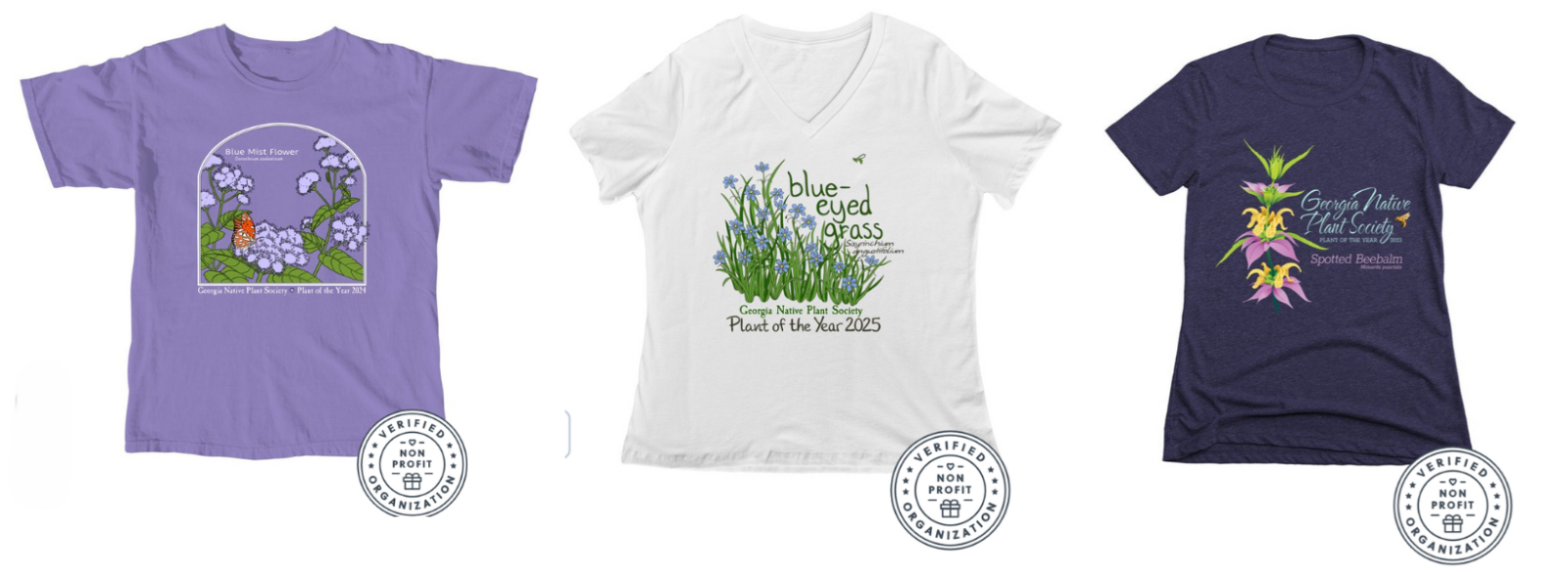
Plant of the Year Gear
While we await the new 2026 Plant of the Year design, grab one of the old ones! Browse our online store for a variety of styles and colors. Each design has both 100% cotton and 60/40 cotton poly blends available - click on “size and fabric info” on each product’s page for the specific details.
.jpg)