Vote for the GNPS 2025 Plant of the Year!
Each year, we celebrate one special native plant by selecting it as GNPS Plant of the Year (POY). The six nominated plants are featured below. POY online voting is EASY. Just go to the voting page*, click to make your selection, and press “Submit.” (If you are not already logged in, you will be prompted to do so before the voting page appears. If it does not appear immediately after logging in, come back here and click that voting page link again.) Online voting will remain open until November 30th. The last few years have seen some really close contests, with only a few votes separating the winner from the runner up. YOUR VOTE MATTERS! So get in there and pick the plant you think is best for POY 2025!
*If the link to the voting page above doesn’t work for you, try copying this in your browser: https://gnps.app.neoncrm.com/survey.jsp?surveyId=29&. You will have to log in as a member, and after doing so, it may be easiest just to click on the link again (or copy into your browser again).

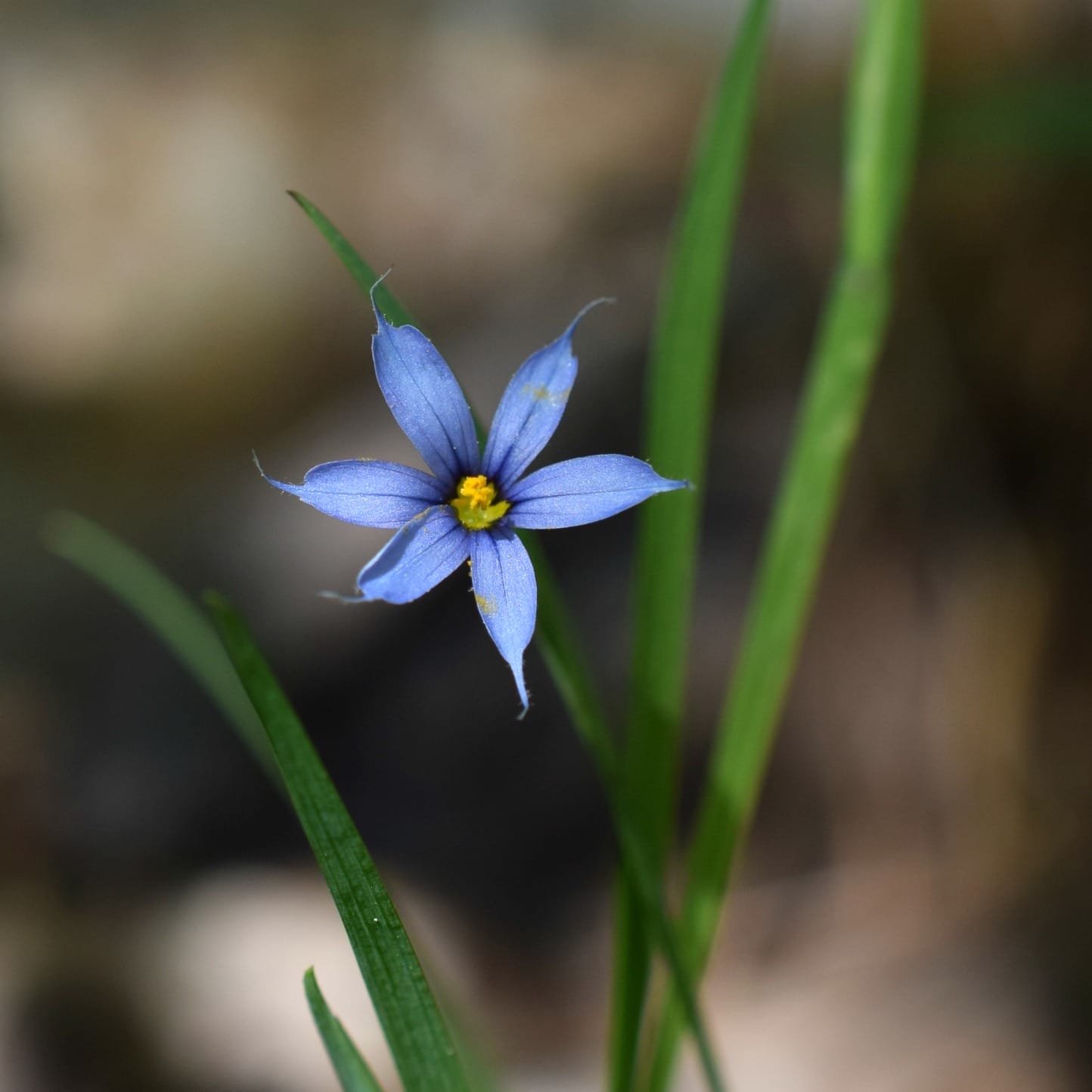
Sisyrinchium angustifolium
Common name: Blue-eyed grass
Family: Iridaceae
Plant type: Perennial
Blue-eyed grass (Sisyrinchium angustifolium) is a member of the iris family. However, it could easily be mistaken for a native grass for much of the year, hence the common name. It grows in clumps, has narrow, medium green, upright leaves, and is typically only about 1-1.5 ft tall. The resemblance vanishes in springtime. From March until June, many flattened, leafless, branched stalks emerge from each clump, slightly taller than the foliage. Individual stalks bear multiple flowers. Only one of them blooms at a time, but a showy floral display is still guaranteed because of the number of stalks per clump. The flowers are small and less than 1” across, but their color really pops. The six tepals are a pale-to-vivid blue or violet. The shade deepens to dark navy (or purple for violet flowers) towards the center, which is a vibrant yellow. The tepals are roughly oval, except that they have a little tip at the end that juts out like a horseshoe crab tail. In the wild, blue-eyed grass can be found in open forest areas, meadows, and water edges. It makes a wonderful ground cover, is attractive to many bees and butterflies, and makes a clever native alternative to the ubiquitous liriope, aka monkey grass. It likes full-to-partial sun and well-drained soils. The roots are rhizomatous, and clumps tend to spread out steadily but slowly over time. Mature plants should be divided every few years to maintain vigor. Blue-eyed grass can also be propagated from seed.
Text by Valerie Boss. Photos by Ellen Honeycutt.


Clinopodium georgianum
Common name: Georgia basil
Family: Lamiaceae
Plant type: Shrub
Georgia basil, aka Georgia calamint or Georgia savory (Clinopodium georgianum) is a terrific autumn pollinator plant. A small, loosely-branched, semi-evergreen shrub, it grows up to 2’ high and 2’ wide. The 4-sided branches become increasingly woody with age, with their tan bark shredding near the base. The leaves are simple, opposite, 1.5” long x .75” wide, oval or rounded, and toothed, with fascicles of smaller leaves growing from the main leaf axils. On immature plants, their undersides can have a purple tinge. From August-October, Georgia basil is festooned with panicles of pale pink or lavender flowers that extend from the leaf axils. The flowers are typically about ½” long and tubular, having a notched upper lip, and a tri-lobed lower lip, dusted with purple specks. Hummingbirds, bees and butterflies love them. Georgia basil is native throughout the southeastern US, although rare in N. Carolina and Florida. In Georgia, it grows mainly in the Piedmont and Coastal Plain. It favors rocky areas, dry woodlands, and sandhills, and will grow in full or partial sun. Commercially available at many native plant nurseries, it makes an ideal species for rock gardens, dry borders, or containers. It is also suitable for low parterre hedges, since it responds positively to pruning and can be cut back by half. It is quite drought-tolerant, and thrives on poor, dry, well-drained soils, provided that they are not too acidic. The leaves of Georgia basil smell like mint when crushed, and their aromatic oils keep deer away.
Credits: Text by Valerie Boss. Photos by Ellen Honeycutt.


Pityopsis graminifolia
Common name: Grass-leaf goldenaster
Family: Asteraceae
Plant type: Perennial
Grass-leaf goldenaster (Pityopsis graminifolia) is a low-growing perennial with abundant bright yellow autumn flowers. For much of the year it appears as a 6-12” high basal rosette of soft leaves with parallel veins. It resembles a broad-leaved grass; in fact, its Latin name “graminifolia” means “grass-like”. From August- October, its appearance changes dramatically, as 1-6 flowering stems, each 1-3’ tall, shoot up from the basal rosette. The upper portions of the stems branch profusely, and have slender, alternate, upturned leaves. Each terminal branch is topped with a yellow, daisy-shaped flower. Ray and disc flowers are the same vivid color, and both are fertile. Grass-leaf goldenaster goes by the alternative name narrow-leaf silk grass because its stems, leaves, and flower peduncles are covered with white hairs, giving the species a silky or silvery appearance. The plant’s natural habitats are dry roadsides, meadows, and areas with sandy, poor soils. This species is a great container plant. It is also well-suited to rock gardens, xeriscapes, pollinator beds, and border edges. It is very drought tolerant and likes it sunny. However, it does not perform well in clay, rich soils, or wetlands. Grass-leaf goldenaster pairs well with purple or blue-flowered species, like liatris or blue mistflower, as well as blue-ish hued grasses like little bluestem. It is a wildlife smorgasbord. Grazing animals feed on the foliage, insects (butterflies, moths, and at least 13 different bees) love the flowers, and birds feast on the insects.
Text by Valerie Boss. Photos by Ellen Honeycutt.


Viburnum nudum
Common name: Possumhaw viburnum
Family: Viburnaceae
Plant type: Shrub
Possumhaw viburnum (Viburnum nudum) thrives in swamps, bottomlands, acidic wetlands, and pond edges. A multi-stemmed and branching deciduous shrub, it can reach 12-15’ tall and be almost as wide. As the plant matures, the stems tend to arch. Leaves are opposite, firm, shiny, 2-6” long, oblong, and medium-dark green, with a prominent center vein. In autumn, they turn rusty maroon, adding vibrant color to a wetland landscape. In spring, flat-topped lacy inflorescences (cymes) appear at the branch termini. Cymes are 2-5” across and fragrant, attracting bees and butterflies. The plant is a host for the Spring Azure butterfly and Lesser Viburnum Clearwing Moth. In autumn, flower heads develop into clusters of drupes. These berry-like fruits start out an eye-catching pinkish shade and gradually darken to an almost-black. Their edibility by humans is debatable, with some websites listing them as toxic and others saying they can be eaten when cooked into jam. Birds certainly like to eat them, and growing them is a great way to support wildlife. Possumhaw viburnum is also called wild raisin or smooth witherod. “Withy or withe” is an old term for a flexible branch, sometimes used in basketry. Possumhaw viburnum is an attractive planting choice for a water garden or other wet area with at least partial sun. The wild type or “species plant” (one that has not been hybridized by man) is carried by some native plant nurseries. It also transplants well from its natural habitat (from a GNPS plant rescue, for instance). If a species plant can’t be found, two cultivars are widely available.
Text by Valerie Boss. Photos by Ellen Honeycutt.
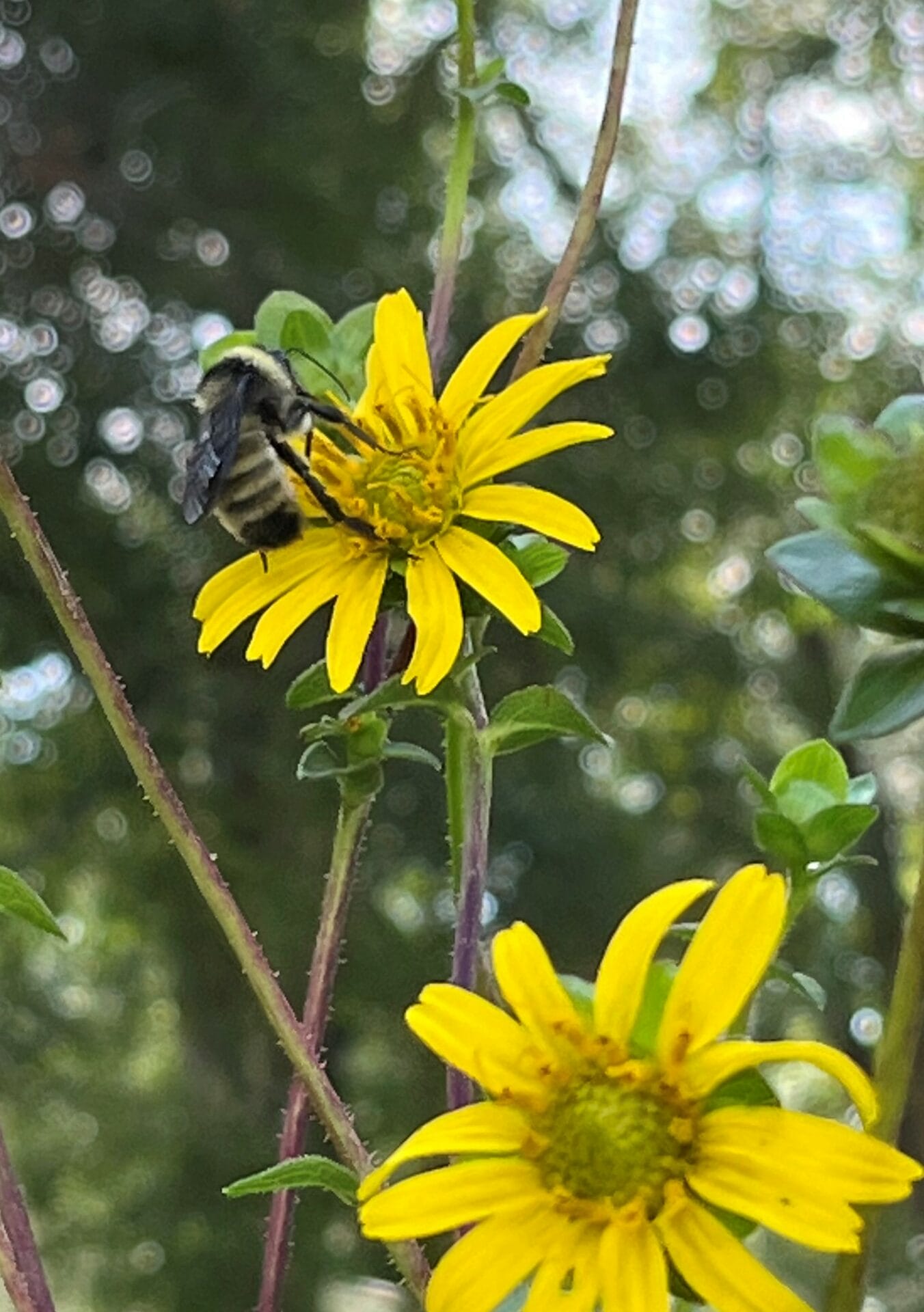
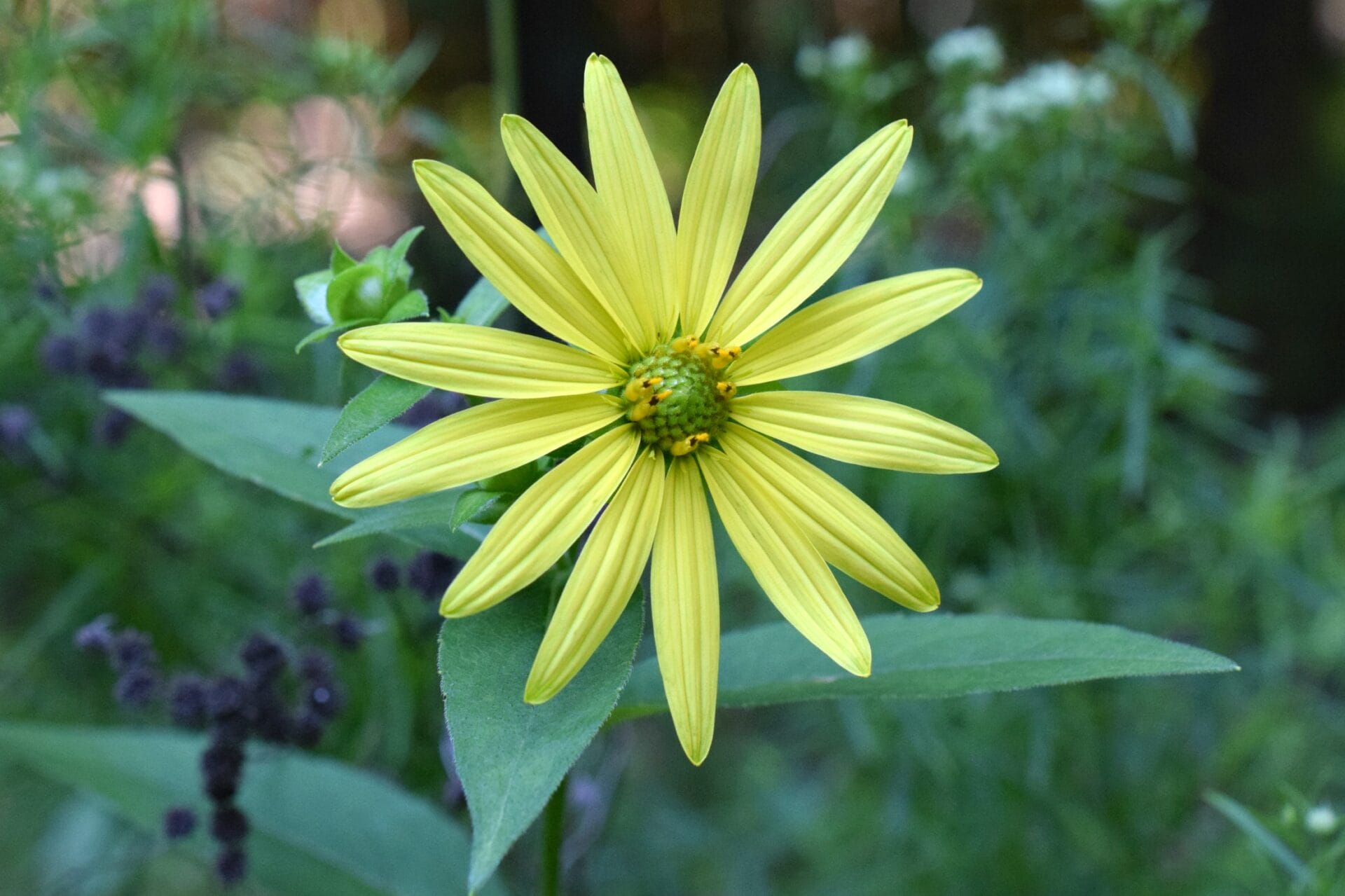
Silphium asteriscus
Common name: Starry rosinweed
Family: Asteraceae
Plant type: Perennial
Starry rosinweed (Silphium asteriscus) is a tall perennial, graced by copious yellow flowers (2.5-3” across) that open from June until October. The common name, “rosinweed” refers to a bitter juice that exudes from the stems when cut. There are 5 subspecies, the most common in Georgia being asteriscus var. asteriscus, described here. Plants vary in height, from 2’ to 7’ tall. Those less than 3’ tall have unbranched, upright, light green, hairy stems. In taller plants, the stems branch and may tilt over if they become top-heavy with flowers. Early leaves form basal rosettes that disappear as leaves emerge on stems. These leaves grow up to 8” long and 3” wide, and are medium-dark green, rough on top, and either opposite or alternate in arrangement. Smaller leaves have complete edges; larger leaves have sparse, widely-spaced teeth. Flowerheads are composites, consisting of a ring of narrow yellow ray flowers surrounding a center of tiny green-ish yellow disc flowers. Silphium disc flowers have stamens, but no pistils. Thus, only ray flowers and not disc flowers produce seed. This arrangement is the exact opposite of its Asteraceae cousin, Helianthus. Starry rosinweed can be found in open woods, roadsides, and meadows. Well-suited to wildflower border plantings and meadow gardens, it thrives in full sun and well-drained soil, but can tolerate some shade. It will self-sow, is resistant to deer and drought, and is a delightful pollinator plant, often covered in bees.
Text by Valerie Boss. Photos by Norris Wooton (with American bumblebee) and Ellen Honeycutt.


Passiflora lutea
Common name: Yellow passionflower
Family: Passifloraceae
Plant type: Perennial
Yellow passionflower (Passiflora lutea) is a climbing vine with palmate leaves and small, showy, flowers. Its delicate, non-woody stems creep harmlessly overtop of trees and shrubs, grasping branches and leaves with coiled tendrils that extend from the petioles. It can sometimes climb up to 20’. Its leaves are wider than long (up to 4” across), with 3 shallow lobes. They are smooth edged, and bright green (sometimes with silver-grey variegations). Yellow passionflower is a prolific bloomer, flowering from June-September. However, its many individual flowers are open for a single day. Each saucer-shaped bloom is roughly 1” across, having 5 greenish yellow sepals, 5 greenish-yellow petals, and a corona consisting of long radiating yellow filaments plus short upright filaments that are purple-ish at the base. At the center of each corona is a stalk supporting 3 long green styles and 5 pale yellow stamens. Yellow passionflower’s pollen is feasted upon by numerous insects, particularly bees. Importantly, it is the only known pollen host for the passionflower bee (Anthemurgus passiflorae). It is also a larval host plant for at least 3 butterfly species. In autumn, even as new flowers are still opening, ovoid green berries (less than 1” long) emerge. These turn purple-black when ripe, and are a food source for small mammals. Yellow passionflower thrives in well-drained soils in full sun to partial shade. Its native habitats are woodlands, thickets and maritime forests. It is an excellent plant for trellis and fence plantings, but tends to spread willy-nilly unless its fruits are removed.
Credits: Text and photos by Valerie Boss.