Old Rucker Park Habitat Restoration Project


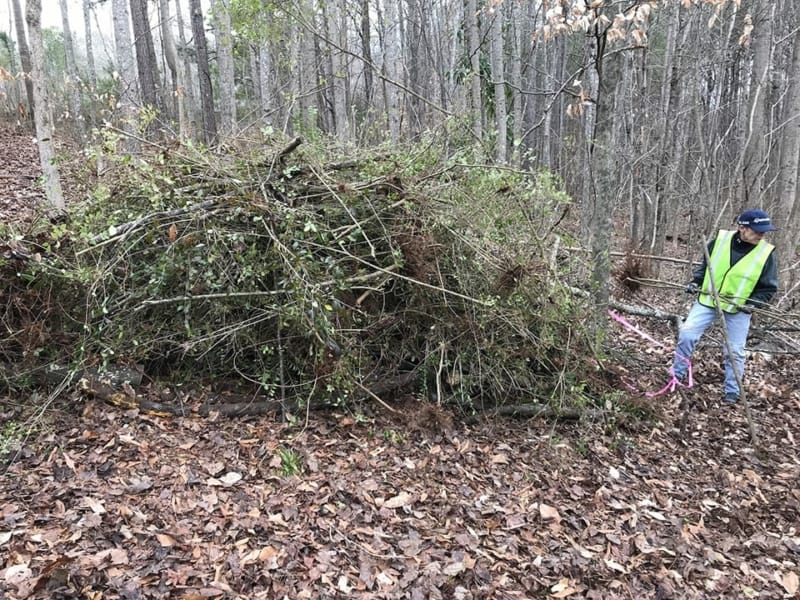

Overview
While primarily known as the hub of the Alpharetta Community Agriculture Program, the 10.5-acre Old Rucker Park also includes nearly 7.5 acres of woodlands and wetlands that are home for some 140 species of native plants. Lying within the Upper Chattahoochee River Basin, the park’s varied topography features several distinct plant communities, ranging from the dry upper slope of the woodlands to the stream that winds through the wetlands.
After touring Old Rucker Park in 2019, Dr. Leslie Edwards, lead author of The Natural Communities of Georgia (Athens, Ga.: UGA Press, 2013), described the site as “a wonderful property, which could demonstrate meadows (prairies), oak-pine-hickory forests, mesic forest, and bottomland/riparian forest.” Unfortunately, Old Rucker Park also has its share of non-native invasive plants, mainly Chinese privet and Japanese honeysuckle, which crowd out naturally growing native plants. However, clearing these invasive plants has already revealed a rich variety of native plants. For example, in one small bottomland area where we removed privet in 2023, we found 28 species of trees, shrubs, forbs, ferns, grasses and vines.
Realizing the untapped potential of the natural history of Old Rucker Park, the Alpharetta Recreation, Parks & Cultural Services department entered into an agreement with the Georgia Native Plant Society (GNPS) in March 2023, to designate Old Rucker Park as an official GNPS Habitat Restoration Site. So that the community could enjoy this rich outdoor resource, the department included in the park’s future development plans an educational trail through the woodlands. In May 2024, that trail became a reality when Nathaniel Smith from Georgia’s Northern Ridge Boy Scout District took on the challenge of constructing the Smith Nature Trail for his Eagle Scout project.
Edwards also acknowledged this potential. “The site possesses clear stories of how humans have impacted the habitat, from terraces to clearing land, with different aged stands,” she said. “Thus, there are numerous educational opportunities here to teach the natural history of Piedmont Georgia’s forests and meadows through the building of trails, perhaps with signage, and developing interpretive materials.” Moreover, she recognized the role the renewed habitat would eventually play in conjunction with the nascent Community Agriculture Program. “Combined with pollinator gardens, orchards, and food gardens, this is a unique opportunity to integrate our appreciation of nature and our role in it,” she said.
Old Rucker Park Invasive Species
The Old Rucker Park Habitat Restoration Project involves removing invasive species and planting appropriate native species in the approximate 7.5 acres of woodlands and bottomlands in the undeveloped sections of this 10.5-acre Alpharetta, Ga., community park.
Old Rucker Park is home to as many as 140 native plant species, with more discovered each time we remove invasive plants from an area. By removing invasive species, the native species can access the moisture, light and nutrients they need to survive.
Though we have identified 30 species of non-native, invasive plants in Old Rucker Park, our removal and control efforts so far have mainly focused on the three most prevalent ones: Chinese Privet (Ligustrum sinense), Japanese Honeysuckle (Lonicera japonica) and Japanese Stiltgrass (Microstegium vimineum) — all classified as Category 1 invasive species according to the Georgia Invasive Species Council.
Invasive plant removal and native plant restoration in Old Rucker Park have been ongoing since the park property was acquired in 2018; however, not until the site became an official GNPS Habitat Restoration Project in March 2023 has a concerted effort been made to remove the acres of invasive species and install appropriate native species.
Those efforts include participation in our first national Weed Wrangle on the Martin Luther King Day of Service on Jan. 15, 2024, and a conservation rescue on May 7, 2024, which involved transplanting native species from a future nearby subdivision site to locations along the new Smith Nature Trail through the woods on the east side of the park.
Most recently, the Alpharetta Community Agriculture Program (ACAP), whose focal point has been Old Rucker Park, has taken an exciting step in sharing the responsibility for habitat restoration by obtaining funding for professional invasive plant removal. The reason for this is simple: Agriculture depends on native plants and the beneficial insects they attract for the pollination of plants that provide a large percentage of the food we eat. The Old Rucker Park Habitat Restoration Project has been the catalyst for this effort, which Amanda Musilli, community services manager for ACAP, says is intended to expand to other Alpharetta city parks as the community agriculture program itself grows.
Volunteers from the GNPS North Metro Atlanta Chapter and various community service organizations meet once a month at Old Rucker Park to work on the Education Garden and Habitat Restoration Project.
Additional Information
- Concept of Old Rucker Park showing principal woodland restoration area with proposed trail. Courtesy Alpharetta Recreation, Parks & Cultural Services
Driving Directions To Wildlife Habitat Garden
From Georgia 400, take the Old Milton Parkway exit and head west. The name of the road changes to Rucker Road in about two miles. Almost four miles from leaving 400, the new entrance to the park is opposite the Old Station subdivision on Rucker Road. The nearest mailbox address is 910 Rucker Road. Old Rucker Road has been barricaded at the west end of the new park.
News & Events
Wrangle With Us on MLK Jr. Day of Service!
Please click on the event you are interested in to check for weather updates. We encourage people to reach out to the event organizer if there hasn't been an update. Georgia Native Plant Society will host its second statewide Weed Wrangle on January 20, 2025...

Weed Wrangle Georgia 2024 on January 15
GNPS will host our first ever statewide "Weed Wrangle" on January 15th, MLK Jr. Day of Service. Weed Wrangle is a one-day, area-wide, volunteer effort to help rescue our public parks and green spaces from non-native invasive species through hands-on removal of...
GNPS to Participate in Alpharetta Community Food Forum
The Georgia Native Plant Society has been invited to participate in the Community Food Forum for Alpharetta residents at Old Rucker Park & Farm on Saturday, December 4, 10-11:30 a.m. Members of the new North Metro Chapter will serve as docents to provide native...
First workday at Old Rucker Road Park restoration project
The first workday for this new project at 860 Old Rucker Road in Alpharetta is Saturday, March 17, 10 a.m. to noon. The City of Alpharetta is donating topsoil and wood chip mulch for the site. Preparation will involve removing the grass,...