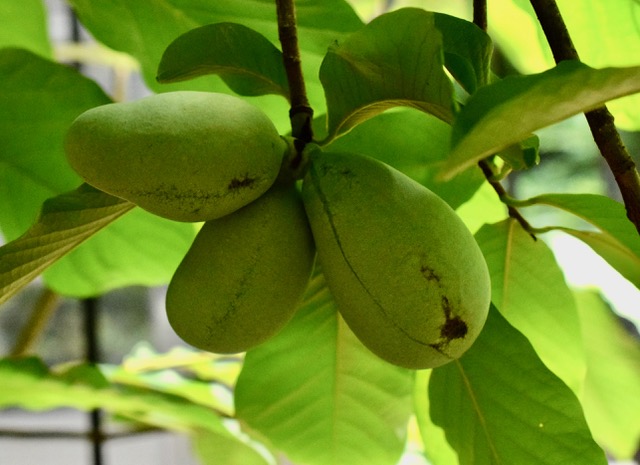
Pawpaw fruits before the leaves turn yellow.
By Valerie Boss
The GNPS Plant of the Year for 2026 is pawpaw (Asimina triloba). Most Americans are familiar with cultivated, non-native fruit trees, such as peaches, oranges, and apples, but are unaware of pawpaw, a native tree that produces the largest edible fruit indigenous to North America. Growing wild in eastern woodlands, but also cultivable, pawpaw’s fruit is both tasty and nutritious. Pawpaw’s range covers much of the eastern US, extending as far north as southern Ontario, west to Nebraska, and south as far as middle Georgia and parts of Texas.
Pawpaw belongs to the Annonaceae family. In 1753, Linneus named it Annona triloba, and in a 1791 travel journal naturalist William Bartram called it Annona grandiflora. Both men placed pawpaw in the family’s type genus, which includes tropical and subtropical fruit trees such as cherimoya and custard apple. Pawpaw was later assigned to the genus Asimina, composed of a small collection—about a dozen species— of Annonaceae members that thrive in temperate regions. Linneus was not the first European to describe pawpaw. That honor falls to Hernando de Soto’s expedition, who came upon native Americans cultivating the plant in the Mississippi Valley in the 1500s.
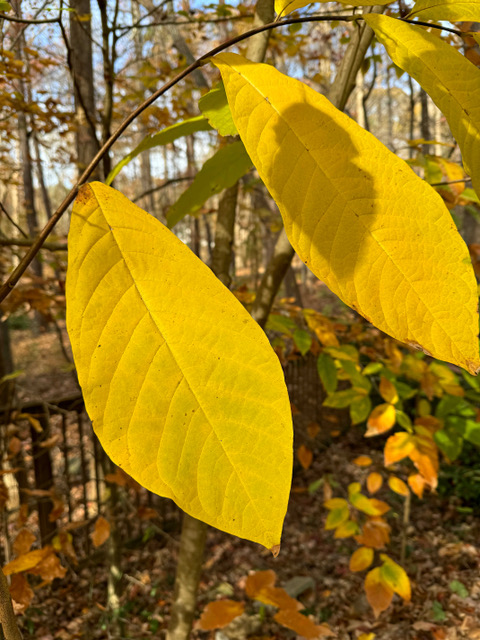
Pawpaw has golden autumn foliage.
Pawpaws are understory trees, reaching as high as 35’. The trunks have grey bark, and the leaves are distinctive, growing up to 12” long and 6” wide. Simple, non-toothed, and elliptical, with slight points at the ends, these leaves have a strong central vein and parallel side veins. They grow in an alternate pattern and tend to droop. The droop is particularly noticeable in saplings, where the stems often arch, pointing the leaves towards the ground. Although they are an ordinary green in summer, the leaves turn a rich yellow in autumn.
Before spring leaves emerge, pawpaw’s flowers burst forth singly from buds along the distal ends of the branches and branch termini. Each flower is about 1-1.5” across, 6-petaled (3 inner and 3 outer), and dark maroon-brown. They smell rotten to people, but their odor attracts beetles and flies, the plant’s main pollinators. Pawpaws also attract the zebra swallowtail (Eurytides marcellus) and pawpaw sphinx moth (Dolba hyloeus). The tree is their larval host.
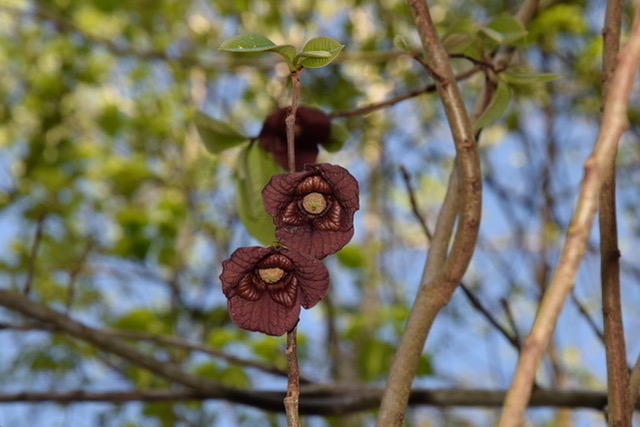
Flowers bloom in early spring.
Nature has ensured that pawpaws don’t self-pollinate. Individual pawpaw flowers are complete (they have both pistils and stamens), but also protogynous–the female parts mature before the male parts, making it impossible for individual flowers to fertilize themselves. In addition, flowers on the same tree are not self-compatible. With the exception of a few cultivars, pawpaw trees reject their own pollen. Thus, only genetically distinct individuals can cross-fertilize.
Pawpaw’s eponymous fruit goes from green to yellowish or brown before falling on the ground when ripe in autumn. Pawpaws are about the size of avocados, but their shape is more mango-like. Their pulp is only ready to eat when the fruit softens (the skin and large, black seeds are inedible). The pulp’s flavor varies depending on the growth conditions and ripeness, but has similarities to banana, papaya and mango. Pawpaws have a caloric value that resembles that of bananas, and contain minerals, Vitamin C, and natural anti-oxidants. Both humans and small mammals like to eat them. Unfortunately, they have a short shelf life.
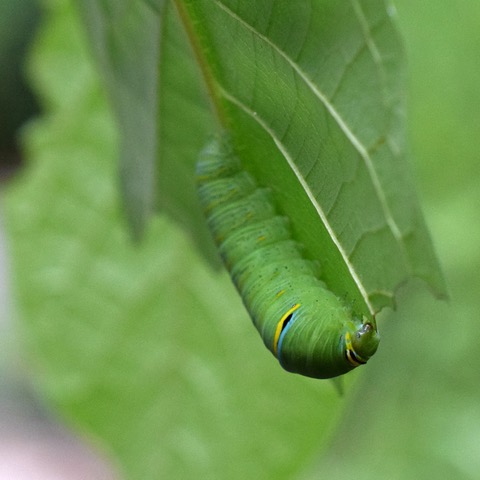
Zebra swallowtail larvae feed on the leaves.
Native Americans, including the Lenape, Iroquois, Algonquin, and Cherokee, harvested pawpaw for food, but also other uses. Powdered seeds were used to control head lice, and fibers from inner bark were woven into bags, twine, and fish nets. Pawpaw was also used medicinally– the leaves, twigs and fruit skin contain acetogenins and alkaloids that are strongly emetic and potentially quite toxic.
Pawpaw trees grow naturally in rich woodlands and hillsides near streams. They are not difficult to cultivate, although the seeds require cold stratification. Pawpaws like partial shade, but can take full sun, provided that they are protected from the afternoon sun as seedlings. Once established, pawpaws can survive short, but not prolonged droughts. Adult trees tend to sucker and form clonal (genetically identical) colonies, so give them room to spread, or plan to cut the clones. Plant two or more seed-grown trees, or trees grafted from different parents, give them moisture and at least partial sun, and in 3-8 years prepare to harvest delicious fruit.
Photos by Ellen Honeycutt.