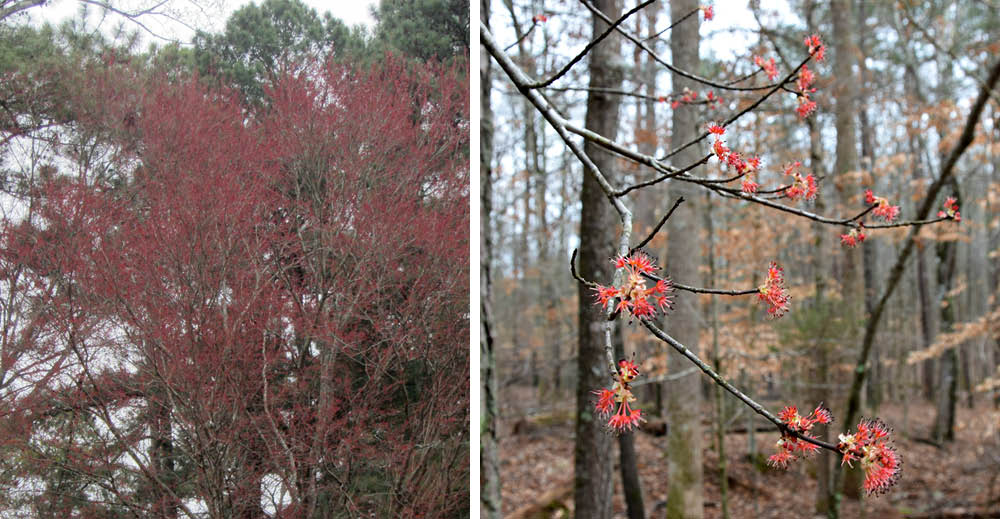
Red maple (Acer rubrum) with flowers in spring.
I believe that red maple (Acer rubrum) is our earliest flowering tree. An oft-overlooked common tree, this native hardwood is found statewide in a variety of habitats. Much admired as a significant contributor to displays of fall color in the mountains, it is less appreciated for its early, but tiny, spring flowers. The bare twigs of maples slowly turn into a haze of red as first the buds swell, then the flowers open, and finally the winged seeds form.
Already I am seeing the flowers on trees in the metro Atlanta area, and I know they are already flowering in south Georgia. These early flowers are important nutrition for a variety of critters. When it comes to early bees, the native bees include mining bees, small sweat bees, mason bees, and cellophane bees. Male bees also use the trees as a place to look for females. Honey bees use the flowers as well.
Bird support is multi-faceted: some small birds will actually eat the flower buds and some of them eat the insects that are attracted to the flowers. Later, other birds will eat the seeds in the winged, double samaras. Later in the season, over 285 different types of moths (such as the Rosy Maple and Cecropia moths) can use the leaves as a host plant, further providing birds with insect food.
The male and female flowers are visually different. You can easily spot the male flowers by the presence of the pollen on the outstretched stamens. Often they are on different trees than the female flowers, but sometimes a tree will have male flowers on some branches and female flowers on others. Female flowers have two red stigmas with no pollen. Both flowers have very small petals surrounding the stamens and stigmas, so small as to not interfere with any wind-dispersal and collection of pollen (in addition to any insect pollination).
Red maple is good landscape choice throughout Georgia, providing significant ecosystem support as well as landscape beauty.
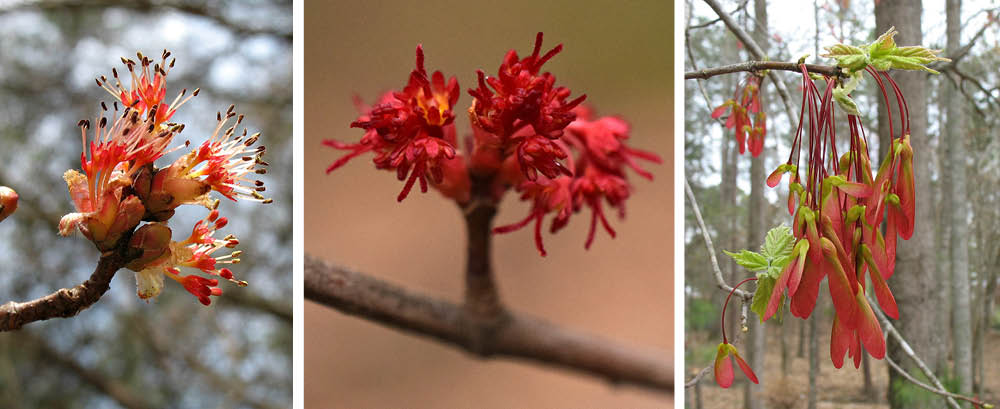
Red maple male flowers (left), female flowers (center) and seeds (right).