Invasive Species Management (Part 4): Understanding Target Plants
Heather Brasell
In previous articles in this series about managing invasive species, I’ve discussed Integrated Pest Management – using a combination of cultural, mechanical, chemical, burning, and biological control methods appropriate to the site, vegetation community, scale of operation, and project objectives. In this article, I’ll discuss the importance of understanding the characteristics of the target invasive plants that influence your decisions for controlling them. I’ll also consider a wide range of control methods, including foliar spray applications that are best used only by people who are trained and experienced with safe and effective herbicide application methods.
Regardless of the project, our overarching goal is to kill the invasive bad guys, without harming the native good guys, wildlife, soil, or water quality. A lot of the decisions you make involve establishing priorities so you maximize your impact with the limited resources at your disposal. In order to do this, it is essential that you can distinguish between the good guys and the bad ones. For instance, you need to know your species well enough to tell the difference between the native Lespedeza virginica and the lookalike very nasty invasive Lespedeza cuneata.
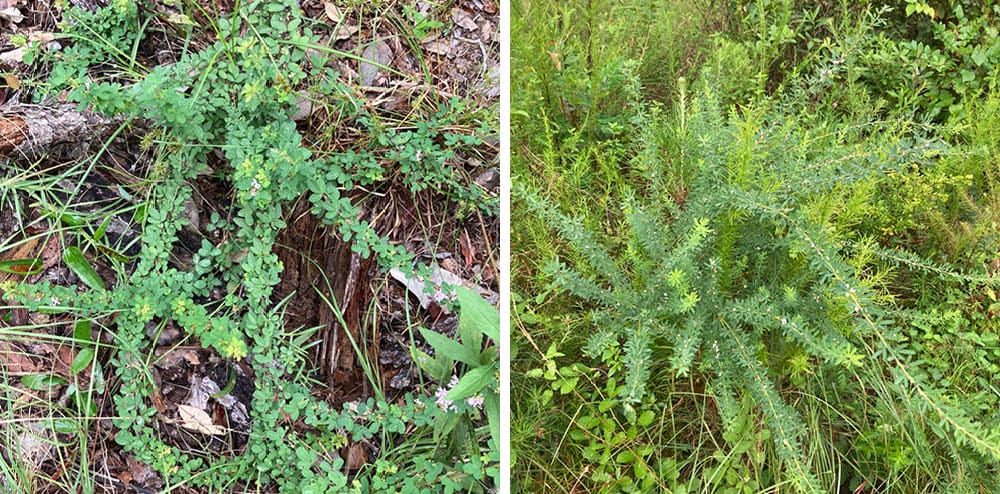
Native Lespedeza virginica / slender lespedeza (left) is easily mistaken for invasive Lespedeza cuneata / invasive sericea lespedeza (right) when it is not blooming. (Photos by H. Brasell)
Annual v perennial: A top priority is to prevent existing invasive plants from reproducing. This means removing all seeds before they mature. If the plant is an annual, you don’t have to kill the whole plant – it will die anyway after the seeds mature. You can remove the seed heads mechanically – mowing or using a sickle – or spot spray with herbicide where there is a dense infestation. However, if the plant is a perennial, you have to kill the roots. Often the best time to kill perennial plants with herbicide (fall) is after seeds have matured. Removing seeds during the growing season before they mature can often buy you time to kill the plants later. I often combine mowing or burning during the growing season to prevent mature seeds, followed by herbicide at the end of summer after the plants have resprouted. Biennial plants often produce a basal rosette in the first year, then grow tall in the second year. This provides a longer window of opportunity to kill them before seed production.
Seed viability: Unfortunately, preventing viable seed production addresses just part of the problem. You also have to deal with past seed production. There are many viable seeds already in the soil. This is a real boon for restoration projects, where seeds from desirable native plants continue to germinate for years after a disturbance. However, it is a huge problem if the seeds are from an invasive species. Seeds from many species germinate or die within five years (short-term persistent), but seeds from some species remain viable for decades (long-term persistent). Unfortunately, this includes many of the invasive legumes. Understanding persistent viability in the soil helps you plan the need for long-term monitoring of sites you are working on. It is difficult to find this information online because it depends not only on the species, but also on the soil properties and the weather.
Seed dispersal mechanism: Knowing the mechanisms of seed dispersal can be useful in knowing where to look for next occurrences of invasive plants (early detection) and for spread from existing populations (monitoring). Some seeds don’t travel far and outbreaks are relatively easy to manage. Some species, such as Chinese tallow, can distribute seeds by water, so you should monitor downstream of the seed-producing tree. Some plants have explosive seed release, for instance violets and some legumes, so the seeds travel further. Seeds from edible fruits can be transported even further. Seedlings can often be found under tree perches (birds) and along animal trails. Humans are responsible for introducing and spreading many invasive species, so it is good practice to monitor roadsides, woods trails, and anywhere that vehicles or equipment has moved through the woods. Of course, the very best practice is prevention. Wind dispersal can carry seeds and spores very long distances so you can find new occurrences even in remote, undisturbed areas.
Weather: Methods that involve roots are generally much more effective if soils are moist and loose. Plants are much easier to pull without breaking when the soil is wet. Foliar applications of herbicide are effective only when the plant is actively growing. If the plants are drought stressed, they shut down and stop translocating the herbicide to the roots. Other herbicide application methods, like cut-stump, are less sensitive to soil moisture. After good rain during the growing season, I continue hand pulling and foliar spray in open areas as long as soils are moist. Soils remain moist for longer in shaded sites, and even longer in wetlands and around ponds. Once the soils become droughty and I see plants wilting in the evening, I move to the cut-stump herbicide application method, which doesn’t depend on transpiration.
Seasonality: We can incorporate seasonal differences among species as we plan strategies for managing invasive plants. In winter, evergreen plants are easier to locate in sites where they are mixed with deciduous plants, and often the soils remain moist for longer. This is recommended as the best time to use foliar applications for evergreen privet in wetlands; deciduous plants like ferns have already lost their leaves and have little surface area to absorb the herbicide. Other evergreen invasive plants that can be treated in winter include English ivy, Eleagnus and Mahonia.
In spring, some plant species leaf out earlier than others, making it easier to spot them. For instance, Japanese honeysuckle is semi-evergreen and easier to find in early spring before other vegetation covers it. The spring leaves also are deeply lobed, making it much easier to identify and distinguish from the native coral honeysuckle. It is surprisingly easy to hand pull.

Native Lonicera sempervirens / coral honeysuckle (left) and lobed leaves of invasive Lonicera japonica / Japanese honeysuckle (right) in early spring when distinctive leaf shapes occur. (Photos by H. Brasell)
Blossoms, often later in spring, make plants much more visible. This is a good time for early detection of invasives and monitoring for survivors after previous treatment. For example, privet, Bradford pear, crepe myrtle, and princess tree emerge from camouflage among other trees to become conspicuous when they are in full bloom. Wisteria blooms are also conspicuous in spring. This is a good time to be confident that you are targeting invasive Chinese wisteria, and not the native American wisteria that blooms a few weeks later with inflorescences that are shorter and more compact.

Wisteria frutescens / American wisteria (left) blooms later than the invasive Wisteria sinensis / Chinese wisteria (center and right). The native wisteria has shorter, more compact inflorescence and leaves are a lighter green and are less pointed. (Photos by H. Brasell)
You can treat herbaceous plants throughout the growing season before the seeds mature, but timing can be tricky. Treating them too early can give them a second chance to produce seeds. Annual grasses can be mowed or have seed heads cut off. However, if they resprout or if some plants germinate later, you may have to apply multiple treatments during the same growing season. Most grasses have seeds maturing in fall, but Italian ryegrass produces seeds in spring. April and May are typically dry months in Georgia, and dry conditions trigger the ryegrass to hasten seed maturity and you may not have much time to act.
Late summer through early fall is the best time to apply herbicide to the foliage of deciduous woody species. At that time of year, the plants start the process of moving sugars from the foliage into the roots for over-winter storage as starches. The herbicide is transported more effectively along with the flow of sugars.
Phenology: Species phenology is one of the most important things to understand in order to plan and implement effective control of invasive species. If a species produces seeds in a single synchronized event, you should be happy. You can prevent seeds from maturing with a single treatment each year at your convenience. Examples include privet and Formosan lily. However, many species produce seeds over a long period, with late seeds germinating after the early germinants have already produced viable seeds. These species need multiple treatments each year to prevent seeds from maturing. Examples include ryegrass, beefsteak, goose grass, hairy indigo and many others.
I have developed a phenology chart for the invasive plants I try to control. Six species are shown below to demonstrate different patterns of plant phenology. Light gray represents the period of flowering, dark gray represents the period of fruiting, dark gray with stripes represents months where flowering overlaps with fruiting. Consider Chinese wisteria and chinaberry. There is at least a month between flowering and fruiting. This makes it relatively easy to time treatments between seeing the blooms in spring and the fruits maturing in fall. With multiflora rose and privet, there is almost no time between flowering and fruit production, so you need to treat the plants much sooner after you see the plants blooming. The real headache is trying to manage plants like kudzu, johnsongrass, and some of the invasive legumes where different individual plants are germinating, flowering, and producing seeds over an extended period. Species like Johnsongrass may require four or five treatments each year in order to prevent seeds from maturing.

Susceptibility to herbicide: In order to minimize herbicide use for foliar applications, you should use the lowest concentration possible needed to kill the target plant. If you use too little herbicide, the plant sickens but doesn’t die; you wasted your time and used herbicide unnecessarily. If you use too much herbicide, you are likely to top-kill the plants before the herbicide reaches the roots to kill the whole plant. You have also used herbicide unnecessarily and may have caused more damage to non-target native plants. Also, to repeat, you are wasting herbicide if the plants are not actively growing (drought stressed or becoming dormant).
The rate needed for many common species is listed on the label of the herbicide container; trained applicators know how important it is to read the label! However, you may have to search to find recommended rates for less common species. Species differ a great deal in the rates needed to kill them. For instance, Microstegium can be killed at a concentration of only 0.25% of glyphosate (a widely-used broad-spectrum herbicide) whereas Smilax requires a 50% solution. Most of the common invasive plants require only 1-2% concentrations of glyphosate, but some of the more resistant species like Japanese climbing fern need concentrations up to 5% glyphosate for effective treatment.
It is important to understand that higher concentrations of herbicide are not more effective in killing plants. If the herbicide dose is too high, the leaves are killed before the herbicide is translocated to the roots. The plant is “top killed” but the roots are not killed; the plant just resprouts.
Leaf surface: Some species have leaves with waxy cuticles that reduce uptake of foliar herbicides. Using a surfactant (surface-acting additive) increases the effectiveness of the herbicide without having to increase the dosage. The surfactant acts like a detergent in lowering the surface tension of the water. The surfactant improves adhesion so the herbicide doesn’t run off the leaf (“sticker”), helps spread the liquid over the surface of the leaf instead of beading (“spreader”), and increases the penetration through the cuticle. This is also a situation where it is recommended to use a selective herbicide rather than a broad-spectrum one.
In summary, the more you know about your target invasive plants, the more effective you can be in early detection, implementing treatments, and monitoring sites to determine the need for additional treatments.