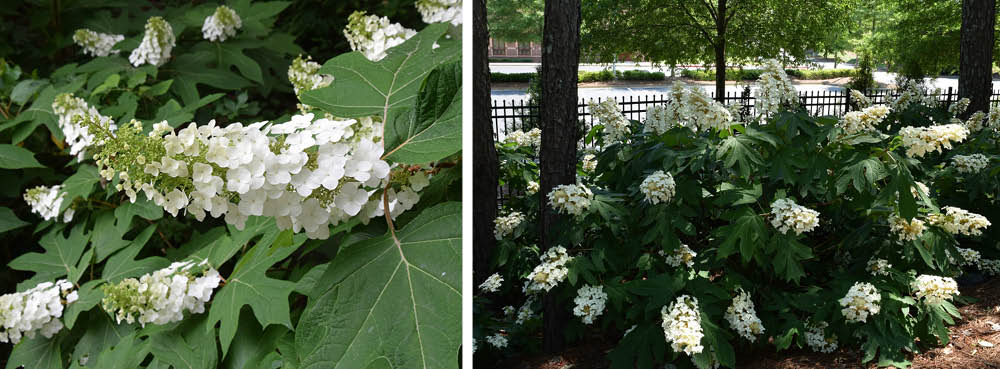
Oakleaf hydrangea (Hydrangea quercifolia).
Oakleaf hydrangea (Hydrangea quercifolia) is probably our best known native hydrangea species, but I’m here to tell you that the others are worth knowing and worth using in our landscapes. With four shrubs and a vine, we have five species of Hydrangea in Georgia.
Oakleaf hydrangea was first documented in Georgia by William Bartram in 1775 in Crawford County. The native range is along the western side of the state (there is much more of it in Alabama). I have seen it in the wild at Cloudland Canyon State Park in Dade County. It is a large shrub, with leaves that resemble those of certain oaks and flowers in a panicle arrangement composed of showy, cream-colored sterile florets and insignificant fertile flowers. The sterile flowers age to pink, giving additional interest to the look of the plant during summer. Fall color can be very nice and exfoliating bark on mature shrubs is said to contribute to four seasons of interest. This shrub is widely cultivated and available at many nurseries. It was our first Plant of the Year when the program started in 2000.
Our second, and most naturally distributed species, is smooth hydrangea (Hydrangea arborescens). A medium-sized shrub, it is rather modest in the wild. Its flat-topped clusters of small fertile flowers only occasionally have sterile florets around the edges. In the wild it is found on shaded streamsides where it helps to hold the bank. It is native to most of the upper half of the state. Nurseries have bred showier forms of this species, creating large balls of sterile florets. The oldest known cultivated one was discovered in the wild near Anna, Illinois in 1910 and later named ‘Annabelle.’ The insects do prefer the wild ones which offer more pollen and nectar.
The next two species are very similar in appearance to the smooth hydrangea. Ashy hydrangea (Hydrangea cinerea) is found in the NW corner of the state, while silverleaf hydrangea (Hydrangea radiata) is in the NE corner. At first glance, one might think both of these are the smooth hydrangea, and they are found in similar areas (shaded slopes, ravines, streamsides). Both were named to reflect the pale coloration on the underside of the leaves which is caused by small hairs. If you’d like to read more about these 3 species and their use in the garden, see this trial garden report of them by Mt. Cuba Center.
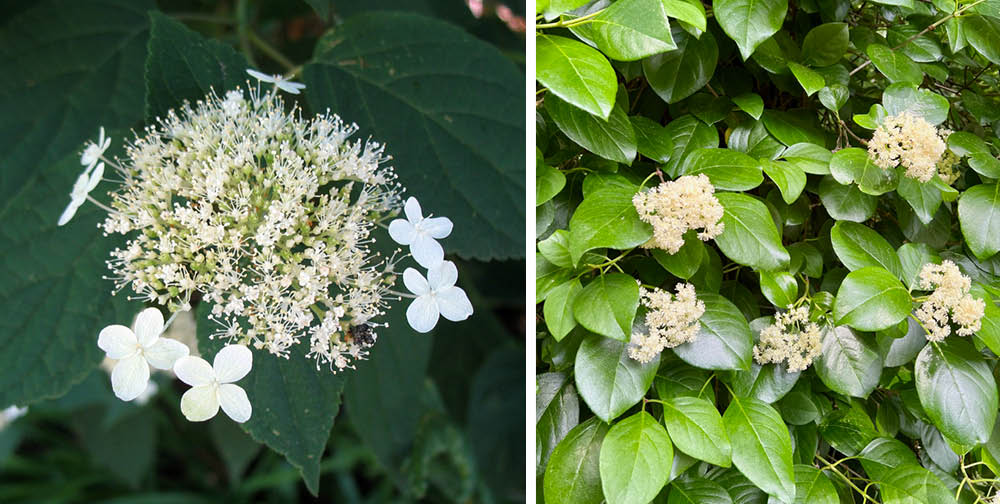
Left: Smooth hydrangea (Hydrangea arborescens). Right: Climbing hydrangea (Hydrangea barbara).
The fifth species is a vine that was previously known as Decumaria barbara but which is now considered to be Hydrangea barbara. It was often commonly referred to as climbing hydrangea but also called woodvamp. This species has almost statewide distribution. Its thick, glossy leaves are arranged in opposite pairs as is true for all hydrangea species. It climbs up trees in moist wooded areas with vines covered in hairs, very much resembling a poison ivy vine; however the leaf arrangement on poison ivy is alternate (impress your friends by pointing out the difference!). The blooms are clusters of small creamy flowers that dry to a cluster of capsules that may still be present in winter as well as a few fading pale yellow leaves. While you might find it scrambling on the ground, it does need to climb in order to bloom.
Look for all of our species of Hydrangea to be blooming now. They are reliable late May to June bloomers. They are all susceptible to deer browsing but with careful siting can be a welcome addition to the native garden.