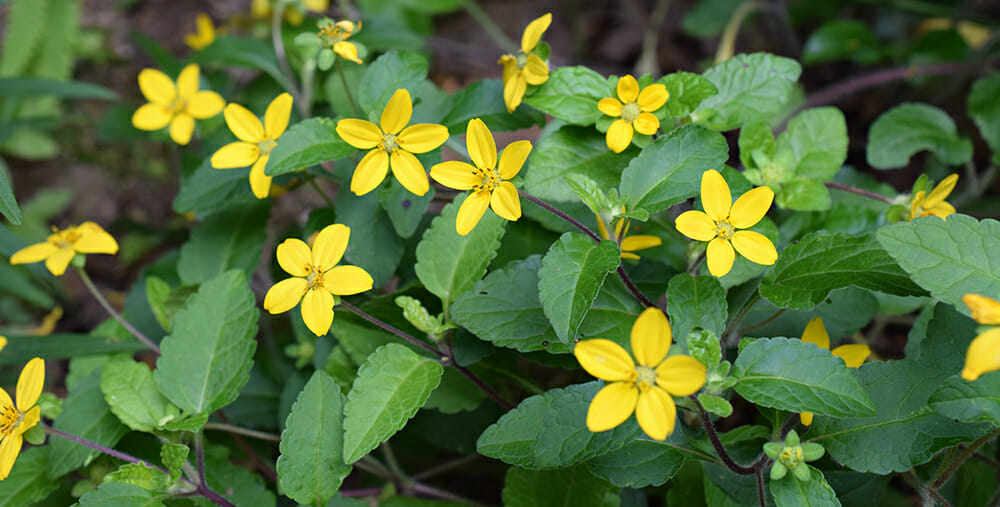
Green and gold (Chrysogonum virginianum var. virginianum).
This month’s spotlight is on a small native, evergreen perennial and groundcover that could be used a lot more in our Georgia gardens. Chrysogonum is a genus uniquely found in the Southeastern U.S. and has a single species, Chrysogonum virginianum, which has three forms, two of which are native to Georgia. Its most common name is green and gold, but it is also called goldenstar.
The three forms are distinguished by their growth habit: spreading forms which have short (var. brevistolon) and long (var. australe) stolons, and an upright form with no stolons (var. virginianum). In case you are not familiar with the word, stolons are horizontal stems that increase the spread of a plant. The first two forms are found in Georgia where you can find them for sale as both species and cultivars. Because of their spreading habits, they are easily propagated by division and shared.
One of the more well-known cultivars is Chrysogonum virginianum var. australe ‘Eco-Lacquered Spider’ which is an aggressively spreading plant whose long, reddish stolons resemble a spider. This particular one was discovered in South Central Georgia and introduced by Don Jacobs via his nursery Eco Gardens in Decatur. This link from Clemson provides names of some of the more common cultivars that you might find at nurseries.
Their evergreen presence in the winter garden is much appreciated and warm days in February often entice an early flower or two to appear. The main flush of composite yellow flowers will be in March and into April when it is pollinated by small early bees. Two other qualities to appreciate: healthy plants form a small groundcover and generally it is deer resistant. Look for it at spring plant sales and add some to your garden this year.
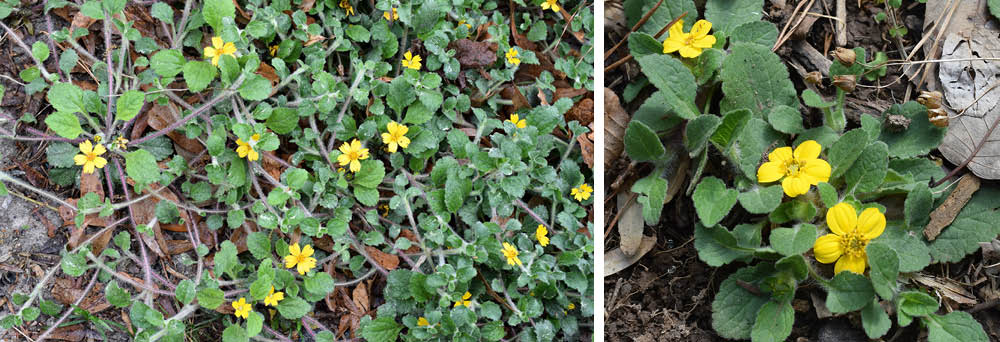
Chrysogonum virginianum var. australe (left) and Chrysogonum virginianum var. brevistolon (right).