Hairystem spiderwort (Tradescantia hirsuticaulis) with green and gold (Chrysogonum virginianum) at Nearly Native Nursery.
There are a number of native spiderwort species, and six are found in Georgia: hairystem spiderwort (Tradescantia hirsuticaulis), hairyflower spiderwort (T. hirsutiflora), smooth spiderwort or bluejacket (T. ohiensis), longleaf spiderwort (T. roseolens), zigzag spiderwort (T. subaspera), and Virginia spiderwort (T. virginiana).

Smooth spiderwort (T. ohiensis).
Many gardeners consider spiderwort to be aggressive but it is smooth spiderwort (T. ohiensis) that is so prolific. Tall, robust, and vividly-blue, you can distinguish it from its relatives by noticing the lack of hairs on the bloom buds (hence the common name ‘smooth’). There might be one or two hairs, but it should be largely hairless. The Virginia Native Plant Society also says: “The smooth spiderwort can be distinguished by non-hairy pedicels and sepals (except for a tuft of hairs at the apex) and its generally glaucous-waxy leaf surfaces.” The foliage might be partially evergreen in Georgia; mine even turns a bit purple some years in winter.
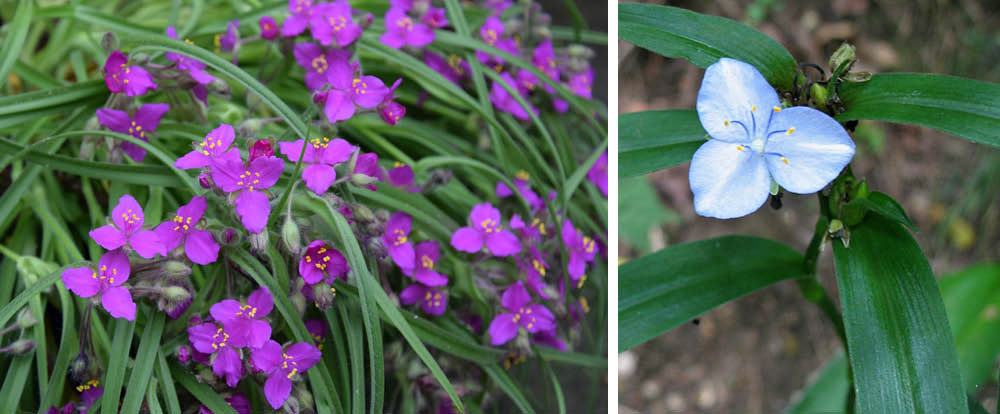
Hairystem spiderwort (T. hirsuticaulis) and zigzag spiderwort (T. subaspera) (with a little zigzag in the stem).
Two of the species are actually named for their hairiness: hairystem and hairyflower. You might think that could be confusing, but they actually have very different natural ranges. Hairystem (T. hirsuticaulis) is one of my favorites and has a variety of different flower shades. Its natural range follows the line of granite outcrops in Georgia. It is perfectly at home in the garden with good drainage. Hairyflower spiderwort (T. hirsutiflora) is naturally found in South Georgia so the only place you’d confuse them would be in a garden that has both.
Longleaf spiderwort (T. roseolens) is another species unique to South Georgia (and rare); we’d be more likely to see it in Florida. North Georgia has its own species in zigzag spiderwort (T. subaspera), with a few appearances in the upper Coastal Plain (and strangely the panhandle of Florida). The crookedness of its stem is a characteristic for it. I have found it easily during the spring while hiking at Amicalola Falls State Park.
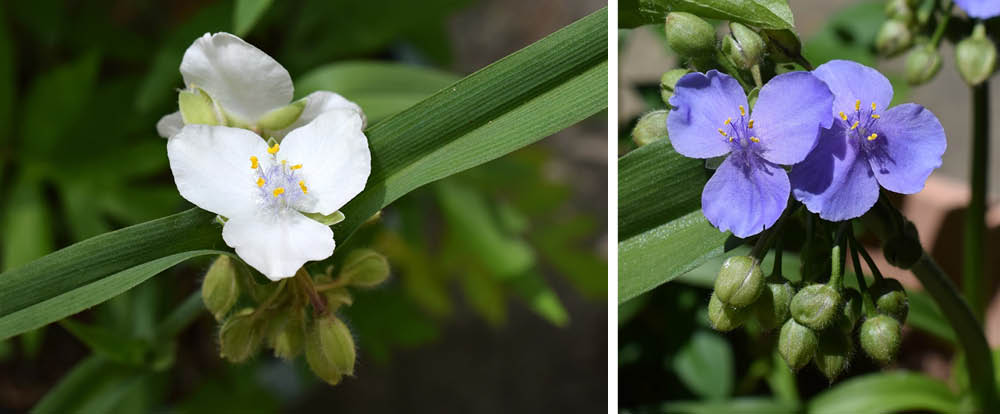
Two color forms of Virginia spiderwort (T. virginiana).
Virginia spiderwort (T. virginiana) has a rather small natural range in Georgia (largely NW Georgia) but has been used in gardens quite a bit. Like the similar smooth spiderwort, it has been passed along from gardener to gardener for many years. Tall like the smooth one, it is distinguished by the small hairs found on the bloom buds and wider leaves than smooth spiderwort.
There are few Tradescantia relatives (Commelinaceae family) that you might come across as well. Callisia graminea, formerly Cuthbertia graminea and Tradescantia rosea var. graminea, is a small plant called grassleaf roseling that is native to south Georgia. Murdannia nudiflora (dewflower) and Murdannia keisak are non-native weedy plants, the latter infesting wetlands, which you might find. A nearby horse field has the tiny Murdannia nudiflora in the shade by the fence and the flower quite resembles a tiny spiderwort bloom. Dayflowers (Commelina sp.)—both native and not—are also similar but a brighter blue in color.