Georgia savory (Clinopodium georgianum).
We all know what shrubs are and what perennials are, but there is a lesser known category called subshrub and this month’s spotlight features one of them. Georgia savory (also known as Georgia calamint and Georgia basil) is a small woody plant that is found in both the Coastal Plain and the Piedmont. I have grown it for years in part-shade conditions where it has thrived as a small, evergreen plant. While it can get up to two feet tall, mine seems to stay at 18 inches.
It has had some name changes over the years. When I was browsing the SERNEC website, I found a voucher from renowned botanist J. K. Small; it was dated September 1894 and he had collected it on Little Stone Mountain (apparently an early name for Panola Mountain). On the voucher, two old names were referenced: Calamintha caroliniana and Satureja caroliniana. Linda Chafin notes in her Wildflowers of Georgia field guide that it has also been Calamintha georgiana. She describes the habit as “dry woodlands, sandhills, and clearings in the Piedmont and Coastal Plain.” Collections in the Piedmont include rock outcrops like Panola Mountain and Arabia Mountain.
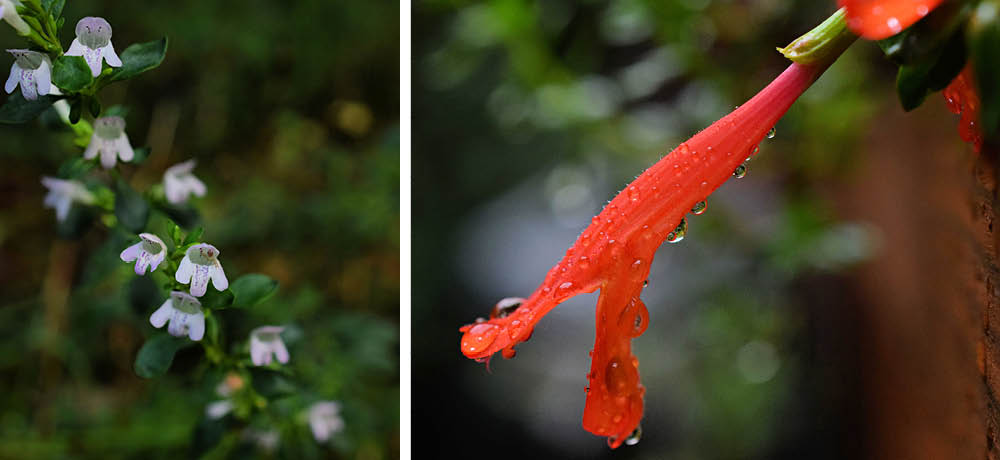
Left: Georgia savory (Clinopodium georgianum). Right: Scarlet calamint (Clinopodium coccineum).
As a member of the mint family (Lamiaceae), it has predictably aromatic foliage and that may be a key reason why the deer don’t browse it in my yard. In September, small pink flowers open along upright stems. Bees love the flowers and I also found a photo by Georgia botanist Jim Allison of a spicebush swallowtail butterfly on it.
Several other species of Clinopodium may be found in Georgia, all of them in the Coastal Plain:
- Ohoopee Wild Basil (Clinopodium ashei), a protected species in Georgia
- Brown’s savory (Clinopodium brownei)
- Scarlet calamint (Clinopodium coccineum)
There is also one non-native species, slender wild basil (Clinopodium gracile), which is quite small and can be a weed in lawns and waste areas. That one may be found statewide (several of my neighbors have it in the North Metro Atlanta area). It blooms in the spring, is only 3-5 inches tall, and spreads by stolons.
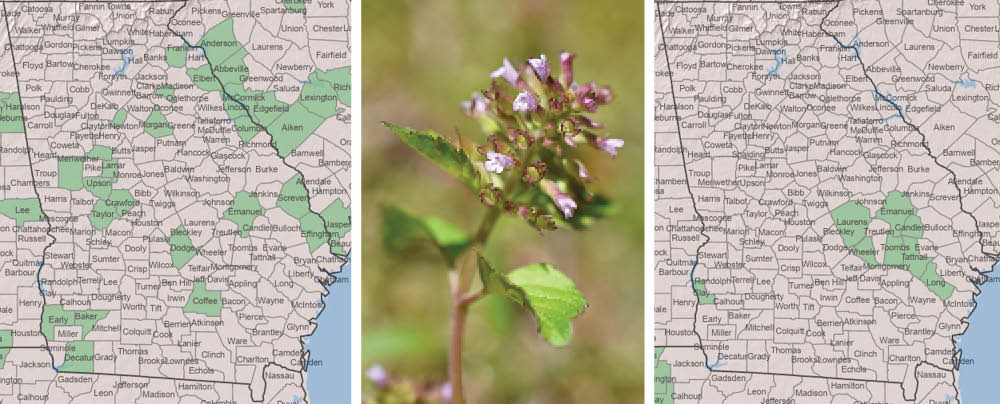
Left: Distribution map of Georgia savory (Clinopodium georgianum). Center: Non-native slender wild basil (Clinopodium gracile). Right: Distribution of scarlet calamint (Clinopodium coccineum).